
ARTICLE - NORTH AMERICA - UNITED STATES - SOCIAL MOBILIZATIONS
From the Criminalisation of Migration to Urban Resistance: How American Cities Defy Federal Crackdowns
Hugo DE MATOS COIMBRA - February 02, 2026
In the United States, 2026 began with violent operations by ICE (United States Immigration and Customs Enforcement), which led to the killing of two people in Minneapolis, Minnesota. As these abuses were filmed and have quickly gone viral, they sparked significant protests. Between a federal administration that embraces its suppressive approach by exploiting immigration issues and a political and civic opposition that strives to resist these authoritarian and violent practices, particularly on a local scale, these events reveal the deep rifts which divide the United States. What does ICE, an agency created as part of the controversial post-September 11, 2001 judicial reforms, symbolizes today? How has the agency evolved since Donald Trump came to power? How is civil resistance organizing in the face of these raids?
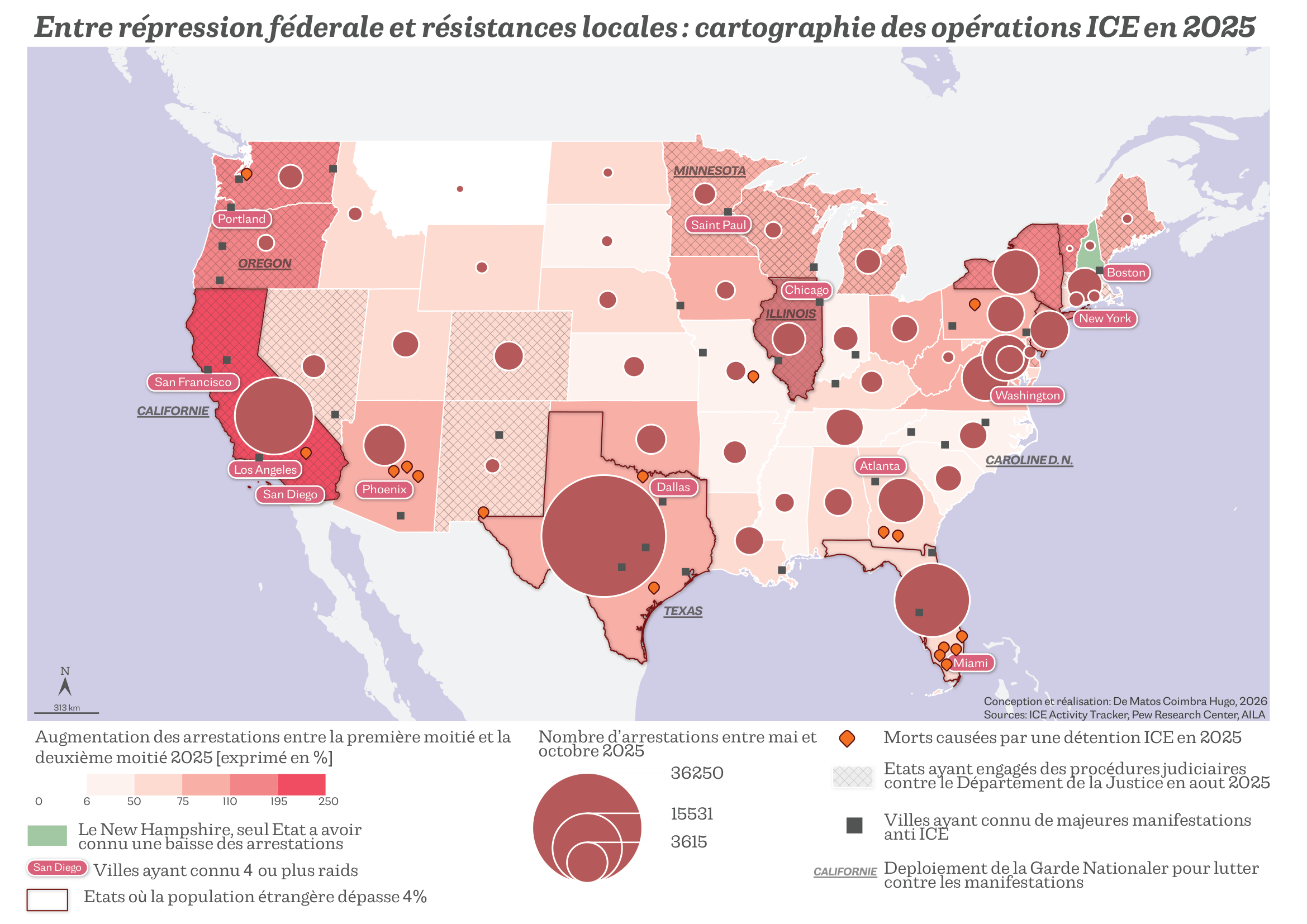
On 7 January, Renee Nicole Good, a 37-year-old American citizen, was fatally shot by Immigration and Customs Enforcement (ICE) near her home in south Minneapolis. The video, which went viral on social media, sparked protests reminiscent—both in scale and in the denunciation of law-enforcement violence they conveyed—of those triggered by the killing of George Floyd in 2020, just a few steps from where Renee Nicole Good was killed. Although the mother was not ICE’s primary target, she was within the perimeter of a large-scale arrest operation involving some 2,000 agents. On his social network, Truth, President Donald Trump described the victim as “a professional agitator, obstructing and resisting ICE¹”.
About two weeks later, Alex Pretti, also 37, was killed in the same city. In both cases, the authorities’ official accounts diverge from those of the families, witnesses, or the footage circulated: while federal agents claim the interventions were defensive responses to threatening behaviour, numerous videos and testimonies suggest that neither of the two people killed posed any immediate threat. To date, no criminal proceedings have been brought against the federal agents, as the Department of Justice has refused to open an investigation.
More than isolated incidents, these scenes symbolise the heightened violence produced by migration policies that were significantly tightened under Donald Trump’s presidency. The hardening of repression against migrants, however, did not begin under the Trump administration. As Tom K. Wong, Professor of Political Science at the University of California, and Karina Shkylan, a researcher on immigration issues, point out, this hardening is “the product of a multi-decade process that gave rise to the homeland security state—one that has cast migrants as an existential threat to the country, making them the target of systematic strategies of control and violence²”.
This increase in repression against migrants has been accompanied by notable resistance within the American population, particularly in historically Democratic cities such as Chicago and Los Angeles.
The Origins of ICE: The Institutionalisation of Domestic Surveillance of Migrants
Traditionally, the United States prioritised control of its external borders—above all the border with Mexico, which by the late 1970s was increasingly perceived as a genuine threat. With the rapid growth of migration flows to the United States, a series of laws soon helped to redirect attention: migrants came to be seen not only as an external danger, but also as an internal one³. US territory was thus framed as being under permanent threat from within. Legislation such as the Immigration Reform and Control Act (1986), the Illegal Immigration Reform and Immigrant Responsibility Act (1996), and the Antiterrorism and Effective Death Penalty Act (1996) contributed to building a legal framework for the surveillance and control of migrants within the country itself⁴.
This heightened criminalisation of migrants and the intensification of domestic surveillance across US territory drew on criminal law with the aim of strengthening migration control. The 11 September 2001 attacks ultimately consolidated the notion of a homeland security state: the Department of Homeland Security (DHS)—distinct from the Department of the Interior—was created to protect the United States from internal and external threats in a context of rising terrorist attacks worldwide. ICE was established in 2003 through the merger of the Immigration and Naturalization Service and the US customs services, under the aegis of the DHS. Today, it employs around 20,000 law-enforcement officers and support personnel across roughly 400 offices in the United States and internationally, including in Latin America and Europe⁵.
When Local Authorities Push Back Against Federal Power
Three levels of policing exist in the United States: local police, responsible for public safety within a limited jurisdiction (a city or a county); state police, operating across an entire state; and, finally, federal agencies such as the Federal Bureau of Investigation (FBI) or ICE, which intervene at the national level in higher-profile matters such as terrorism, federal crimes, and immigration control. Traditionally, the enforcement of immigration law fell almost exclusively to the federal level, with local and state police forces formally distinct from such responsibilities.
Nevertheless, as Jennifer M. Chacón, Professor of Law at the Massachusetts Institute of Technology and a specialist in immigration law, notes, “immigration enforcement is now heavily funded and deeply integrated into everyday policing practices within US territory⁶”. This proximity between local policing and immigration control has, over the past three decades, been expressed through a range of programmes and agreements that have enabled local police to perform certain immigration-control functions under federal supervision. The Secure Communities programme, designed under the George W. Bush administration after 11 September, aimed to link arrests made by local police to federal immigration databases in order to more easily identify individuals eligible for removal; it offers a salient example of how the United States has incorporated criminal law into its immigration-control apparatus. The Obama administration introduced several programmes such as Deferred Action for Childhood Arrivals (DACA), intended to provide temporary protection to young immigrants who arrived in the United States as children by granting them work authorisation and deferring their deportation. Yet these same programmes simultaneously reinforced a long-standing hierarchy among migrants, distinguishing those deemed “deserving” because they contribute to the country’s economic development from others, perceived as dangerous and deportable⁷. Finally, under Joe Biden’s presidency, certain measures sought to reintroduce more individualised approaches, limiting removals to cases presenting a genuine threat to public safety rather than targeting all irregular migrants.
Recent episodes have underscored the tensions inherent in the US system of immigration policymaking. Two principles collide: on the one hand, decision-making authority over immigration policy lies at the federal level (primarily Congress and the President); on the other, the federal government cannot compel states and municipalities to implement federal immigration policy. In other words, they retain significant room for manoeuvre in deciding the extent of their cooperation with federal immigration authorities and may therefore refuse to cooperate with ICE. Several cities—such as Los Angeles, New York, and Chicago—have thus become “sanctuary cities”, i.e. cities that adopt measures designed to limit cooperation with federal agencies. Chicago’s official website states that “the City will not ask about immigration status, will not share this information with authorities, and, above all, will not deny you access to municipal services on the basis of immigration status⁸”.
On 6 October 2025, Chicago’s mayor, Brandon Johnson, signed an “ICE-free zones” measure establishing clear rules prohibiting ICE agents from using any city-owned property in the course of their operations⁹.
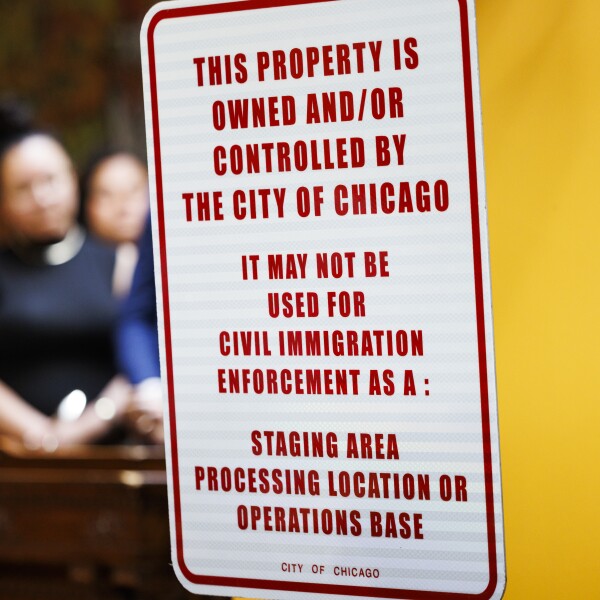
Signage prohibiting ICE from entering property owned by the City of Chicago. (Source: Chicago Public Media)
Trump II and the Surge in Repressive Measures Against Migrants
Donald Trump’s second presidency marks a break with the migration policies pursued by his predecessor. After making the fight against immigration a central plank of his presidential campaign, a series of budgetary and political measures were introduced to make the “hunt for immigrants” more effective. In 2026, ICE’s budget reaches $11.3 billion, with 20,000 posts, and the One Big Beautiful Bill Act provides between $120 and $170 billion for the period 2026–2029¹⁰. This funding is set to support the construction of 50 new detention centres. Arrest numbers have also surged across all states, with the exception of New Hampshire. While 270,000 people were deported by ICE in 2024, the number rose to 400,000 in 2025, according to the Department of Homeland Security¹¹. Some states recorded a 254% increase in detentions between the first and second halves of the year.
The states experiencing the sharpest rises in detentions are not necessarily those with the largest migrant populations, but rather those that contain sanctuary cities. Thus, Florida—ranked third in terms of migrant population (4.6 million, or 10% of its population)—saw arrests rise by “only” 56%. By contrast, states such as Oregon and Illinois, where migrants represent a relatively small share of the population—0.9% in the former and 4% in the latter—experienced a dramatic increase in arrests: Illinois rose from 957 arrests in January–May 2025 to 2,807 by mid-October 2025, while Oregon increased from 216 to 595 over the same period¹². Both are considered sanctuary states by the Department of Justice.
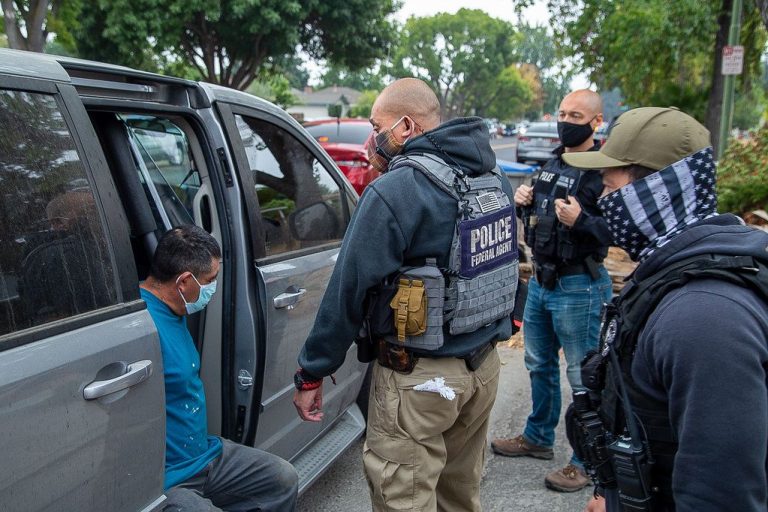
The policies adopted by sanctuary cities and states clash with Donald Trump’s migration agenda. Faced with the refusal of certain cities to cooperate with ICE, the President has employed various methods to pressure states into enforcing federal law. Multiple attempts to strip sanctuary cities such as Boston, Chicago, Denver, or Los Angeles of federal funding on the grounds that they limit cooperation with ICE were ultimately blocked by the courts. More coercive methods are now being used. In particular, the number of raids—sudden, coordinated federal operations in which large numbers of federal agents move into specific areas with the aim of detaining and deporting undocumented immigrants—has increased sharply. Cities such as Portland, San Francisco, and Dallas have experienced repeated raids. The large-scale raid launched by Donald Trump on 6 January 2026 in the Minneapolis area is the most widely publicised example. Officials described it as “the largest immigration operation of all time”, deploying around 2,000 federal agents. It was during this raid that Renee Nicole Good was killed.
From Repression to Civil Resistance
In response to ICE’s repressive actions, protests have emerged. According to the independent global monitoring project ACLED (Armed Conflict Location and Event Data), more than 700 demonstrations linked to Donald Trump’s immigration policies were recorded across the country in 2025, setting a record¹³.
Civil resistance has also taken other forms. Michelle Goldberg, a journalist at The New York Times who covers politics, religion, and women’s rights, describes the spontaneous, community-based methods adopted by Minneapolis residents: “People brought out whistles; they set up their own small alert system to warn that ICE had entered a neighbourhood. They protest. They mobilise to defend their neighbours¹⁴.” Collaborative websites have also appeared: iceinmyarea.org allows anyone to report the presence of ICE agents and provides legal resources to help migrants understand the full extent of their rights. In an article for The New York Times, Julie Bosman explains how ICE actions have generated a repertoire of civil-resistance practices: the establishment of rapid-response networks; tactics for tracking ICE vehicles and using whistles to warn the neighbourhood; and identifying the hotels where ICE agents are staying in order to make noise and keep them awake are among the actions carried out by Chicago residents¹⁵.
What Are the Implications for the US Security and Judicial Systems?
As Elisa Jácome, an economist specialising in criminal justice and immigration at Northwest University, already noted in a 2021 study¹⁶, immigrants’ mistrust of the police significantly reduces their willingness to report crimes, including when they are themselves victims or direct witnesses. While specific programmes—such as the Priority Enforcement Program (PEP)—have slightly strengthened trust between Dallas’s Hispanic population and law enforcement (the number of serious crimes reported to the police by Hispanic complainants increased by around 4% after the programme was introduced), the continued stigmatisation and criminalisation of immigrants only further strain a judicial system that is already under pressure. Although the study focuses solely on Hispanic populations, it is reasonable to expect that the intensification of protests against ICE will gradually extend this mistrust to the broader American public, including citizens with no immigrant background. This dynamic erodes confidence in security and judicial institutions, undermining the community cooperation essential to an effective justice system. This loss of trust in security institutions is felt even more acutely among immigrant communities, who now fear near-systematic arrest and deportation.
Today, migration repression appears as one of the central pillars of US security governance. It forms part of a long-term process that has progressively embedded immigration control at the heart of criminal law and local policing practices. The strengthening of ICE, the proliferation of raids, and the expansion of detention infrastructures reflect a coercion-based approach whose effects now extend far beyond migrant populations, affecting the wider public that challenges immigration policy. In the face of this intensified repression, urban resistance and the policies of sanctuary cities have emerged as direct responses to the criminalisation of migration. By refusing to cooperate with ICE, these cities challenge a form of federal repression that—far from ensuring security—weakens institutions and crystallises tensions between security, justice, and democracy in the United States.