
Analysis of the Berlin regional elections: Fundamental rights and class ties
İlker ATAÇ
25 octobre 2026 The Turkish version of this article has been published by 1+1 Express.
In the Berlin regional elections on September 20, Die Linke (The Left Party) defied the odds by finishing first. This success can be attributed in large part to the party’s ability to champion the long-standing struggle for the right to housing, to incorporate—to a certain extent—the movement of solidarity with Palestine, and to mobilize, within a “post-migrant” city, many segments of the population that had previously shunned the polls. Here’s a look back at this electoral dynamic, the transformation underway within Die Linke, and the prospects for the future that emerge from it.
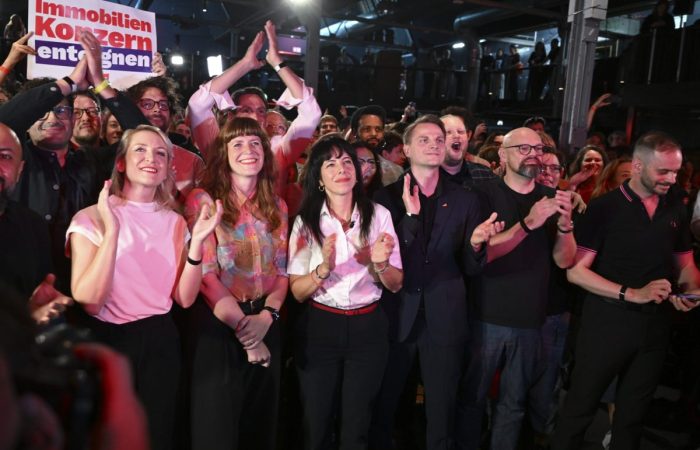
In the Berlin regional elections on September 20, Die Linke (The Left Party) came out on top with 25.7% of the vote. Support from young people, voters who had previously abstained, and German citizens with immigrant backgrounds played a decisive role in this victory. While the far right, led by the Alternative for Germany (AfD), is on the rise in eastern Germany, Die Linke—which was polling at around 22% in the latest surveys—exceeded all expectations in this dual regional and municipal election.
Although its own supporters had doubts about its ability to gain local power, the party more than doubled its share of the vote compared to the previous election. The Christian Democratic Union (CDU), which had previously held the mayor’s office and was polling at 21%, was hot on the heels of Die Linke.
The final stretch of the campaign was marked by this close race between Die Linke and the CDU. However, the CDU fell by 9.5 percentage points compared to the last election, settling at 18.8%. In third place, the AfD gained 7.2 percentage points to reach 16.3%, marking its highest-ever result in Berlin.
Nevertheless, unlike in other recent regional elections, the AfD failed to double its share of the vote in the capital. The Greens slipped to fourth place with 14.3%, while the Social Democratic Party (SPD) fell to fifth place with 12.1%. Both parties thus lost between four and six percentage points compared to the previous elections.
Young people, former nonvoters, and people with immigrant backgrounds
Support from young people played a decisive role in Die Linke’s victory. For the first time in these elections, 16- and 17-year-olds were eligible to vote. Among voters aged 16–24, 47% voted for Die Linke. In this age group, the Greens, who came in second, received only 11%, while the AfD garnered 10%, the SPD 9%, and the CDU 8%.
Among 25- to 34-year-olds, Die Linke also won nearly one in every two votes. Berlin certainly stands out from other German cities due to its large young population, high level of education, diverse employment opportunities, cosmopolitan social structure, and, above all, its historical roots on the left.
However, the most decisive factor in this victory lies in the party’s ability to re-engage non-voters. Die Linke thus captured the votes of 75,000 voters who had not gone to the polls in 2023, even outpacing the AfD in this segment, as the latter had attracted 65,000 former non-voters.
Yet, two weeks before the Berlin election, during the regional elections in Saxony-Anhalt, the AfD owed its rise largely to the support of former non-voters. At the same time, Die Linke managed to win over 51,000 voters who had voted for the Greens in the previous election and 37,000 voters from the SPD’s ranks.
The Berlin result thus demonstrates that non-voters do not inevitably swing to the right. According to journalist Sebastian Friedrich, this electoral segment—which has sparked heated debate in Germany due to its strong mobilization by the AfD—is by no means a socially or politically homogeneous group. It consists in part of chronic non-voters, voters disappointed by the parties they once supported, and young people. The proportion of low-income households in precarious socioeconomic situations is particularly high among this group. Consequently, the central issue is determining who is capable of meeting these voters’ expectations and toward which political channel their accumulated discontent can be directed.
In Berlin, people with immigrant backgrounds made up a significant portion of the electorate that had abstained in previous elections. By voting for Die Linke’s mayoral candidate, Elif Eralp, the citizens who felt represented were not limited to voters of Turkish origin, but also included people from other immigrant communities. Elif Eralp emphasized this during a press conference held the day after the election: “Those who have lived here for decades are not foreigners; they are Berliners.” This statement can be seen as an expression of renewed political confidence and self-awareness among Berliners with immigrant backgrounds.
The rise of the right is not inevitable
Also in September, during regional elections held in two eastern German states—Saxony-Anhalt and Mecklenburg-Western Pomerania—the AfD succeeded in establishing itself as the main alternative to the federal government, the traditional parties, and the political status quo. These elections were largely shaped by the possibility of the AfD coming to power at the regional level. Voters for other parties, in fact, based their decisions largely on blocking a potential government led by the far right. Despite this, the AfD managed to finish first in both of these states.
This is a topic that deserves an article of its own. However, the analysis by East German sociologist and activist David Begrich on the AfD’s racist rhetoric proves particularly illuminating. According to Begrich, a large portion of the AfD’s electorate is fully aware that a government led by this party will not solve their economic difficulties. Nevertheless, even if their own situation does not improve, the prospect of a deterioration in the living conditions of “others”—such as people of immigrant origin, asylum seekers, and queer people—significantly bolsters the appeal of the far-right party. The erosion of social solidarity and the widespread feeling of “no alternative” in the face of multidimensional crises are among the main driving forces behind the radical right.
In Berlin, by contrast, political discontent has found expression in a politics grounded in social class and centered on concrete goals and demands, rather than stoking identity-based divisions. This dynamic shows that the rise of the right—made particularly striking by the election results in eastern Germany—is by no means inevitable.
A class-based strategy
Die Linke focused on issues that directly affect the vast majority of Berlin’s population: skyrocketing rents, the prohibitive cost of public transportation, as well as rising food prices and access to sports facilities. The condition of the streets—which are rarely cleaned in many neighborhoods—and waste management were also central to the campaign. In particular, Die Linke proposed the creation of neighborhood cafeterias to ensure that everyone has access to affordable, high-quality food. These demands were communicated to the public through direct engagement methods, such as door-to-door canvassing and the organization of a large “tenants’ assembly.”
In an era marked by polarization, this class-based strategy was a highly deliberate choice. That is why the severe housing crisis was placed at the center of the campaign. As soaring rents and the right to housing emerged as the central issues of the election, Die Linke adopted a confrontational and combative stance on the matter.
For example, the party has made the effective implementation of the socialization of large real estate conglomerates a prerequisite for any governing coalition—a measure approved by a majority of Berliners in the citizens’ initiative referendum on September 26, 2021. In this way, Die Linke has made one of society’s fundamental dividing lines its own.
Die Linke’s election platform also aims to freeze public transportation fares, make public transportation free for schoolchildren and students, and reduce the cost of the social transit pass for low-income households to nine euros per month.
Under the plan, access to public swimming pools will be free for everyone under the age of 18. “Neighborhood cafeterias,” opened in every district, will offer healthy meals starting at three euros. During the first 100 days of the term, rents for housing owned by the State of Berlin will be frozen for one year. Thereafter, rent increases will be capped at a maximum of 1% per year. Die Linke also pledges to build 7,500 new municipal public housing units each year and to increase taxes on luxury real estate.
The inspiration behind this electoral strategy is, in fact, no secret. Several party leaders traveled to New York to closely study Zohran Mamdani’s campaign for mayor. The slogan “Make Berlin Affordable” (Berlin bezahlbar machen) was a direct reflection of the “affordability” campaign—that is, the financial accessibility of the cost of living—led by the Democratic Socialists of America (DSA) in New York.
The impact of the tenants' movement
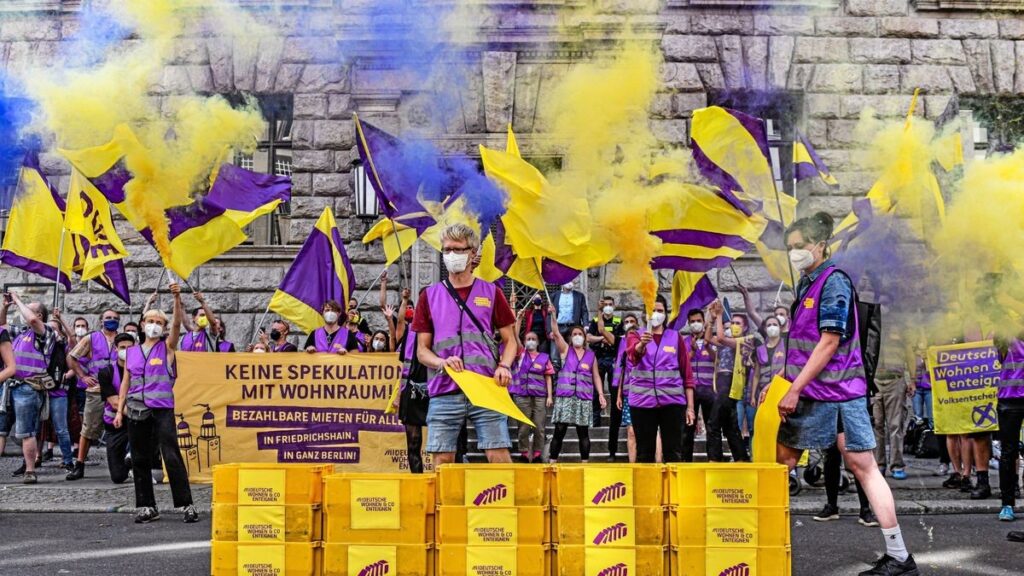
This electoral success cannot be understood without taking into account the tenants’ movement, which has been remarkably well-organized in the city for many years. In the citizens’ initiative referendum on September 26, 2021, 59.1% of Berlin voters supported the socialization of large real estate corporations. Furthermore, if we include foreign residents who are not eligible to vote, nearly four out of five Berliners supported this expropriation measure.
The tenant collectives behind the “Deutsche Wohnen & Co. Enteignen” (DWE) campaign had succeeded in transforming a model of affordable housing—removed from market forces and managed democratically—into a concrete solution supported by an overwhelming majority of the city’s residents.
This victory was the culmination of patient, long-term organizing work by the tenants’ movement. In April 2018, in the wake of a major demonstration against rent hikes that drew more than 25,000 participants, a new alliance was formed to demand the expropriation of the capital’s largest real estate giant, Deutsche Wohnen, as well as its counterparts.
This coalition brought together Deutsche Wohnen tenants, housing rights organizations, and seasoned activists. Among the driving forces behind this movement was the Kotti & Co. initiative, which has been campaigning for years at Kottbusser Tor Square in Kreuzberg in favor of the remunicipalization of former public housing.
The core of the campaign centered on direct, door-to-door interactions, while meetings took the form of open assemblies accessible to everyone. This approach helped spread activist know-how and organizational awareness widely throughout the city. Cooperation with local tenant groups and the formation of neighborhood teams were the essential building blocks of the movement. Thanks to this network, thousands of activists joined the movement, giving housing demands a strong popular base.
From a legal standpoint, the campaign was based on Article 15 of the German Basic Law, which had remained a dead letter until then. This article authorizes the transfer of land and means of production to collective ownership in exchange for compensation. The text approved in the referendum thus provided for the transfer of assets from private real estate companies owning more than 3,000 housing units in Berlin to a public-law entity.
As a result, approximately 240,000 housing units would be socialized and removed from market forces. Rents for this housing stock would then be regulated, and the public sector’s share of the housing market would double to 40 percent, which would also strengthen public control over the private rental market.
One of the most innovative aspects of the campaign was that its goal was not merely nationalization, but rather the genuine socialization of housing. The board of directors of the independent public agency to which the housing stock was to be transferred would have been composed primarily of representatives from tenant collectives and members of civil society. The bylaws of this democratically managed institution would have prohibited any future reprivatization and set compensation for real estate funds below market value.
Housing was no longer to be treated as a commodity or mere state property, but was to become a common good. Indeed, in the event of a direct transfer to traditional state housing agencies, tenants’ decision-making power would have risked being curtailed, governance would have become bureaucratized, and housing units would have been put back on the market at the whim of changing governments.
However, the text put to a vote was not a binding law, but a resolution urging the Berlin Senate to take the necessary legislative steps toward socialization. The CDU-SPD coalition that subsequently came to power chose a radically different course: it merely had the regional parliament pass a token framework law—little more than a smokescreen—that did not socialize a single housing unit.
The structural transformation of Die Linke
The rapid transformation taking place within Die Linke is strikingly reflected in the composition of its activist base. At the end of 2024, the party had 8,300 members in Berlin; by September 2026, that number had surpassed 19,000. Die Linke thus overtook the Greens during this election year to establish itself as Berlin’s leading political force in terms of membership. A similar trend can also be observed nationwide.
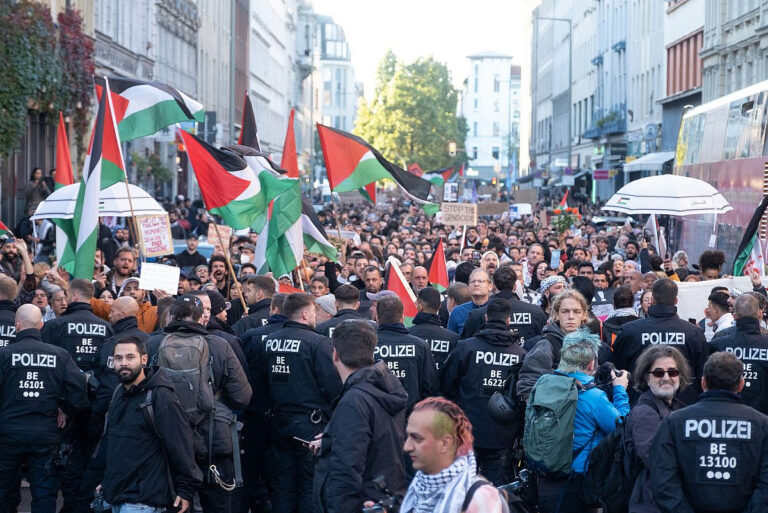
While the average age of party members was over 50 in 2023, it fell below 40 in 2026, making Die Linke the party with the youngest membership base among all parties represented in the Bundestag. The proportion of female members has increased by more than 8 percentage points over the past five years, reaching 45.5%. A significant portion of these new recruits consists of young people who became politically active through the protests against the genocide in Palestine.
In southern Berlin, the working-class and popular district of Neukölln—characterized by a large immigrant population and subject to rapid gentrification in recent years—has seen its local chapter of Die Linke emerge as a central player in the party’s radical wing. In the September election, the party won half the votes in northern Neukölln, far outpacing all of its competitors and securing three seats in the regional parliament.
The Ferat Koçak case
This success was no accident. In the February 2025 federal elections, Ferat Koçak became the first candidate from Die Linke to be elected to the Bundestag through direct vote in a district located in what was formerly West Germany. Born in Kreuzberg and raised in Neukölln, this 47-year-old man—who has been at the forefront of anti-racist and anti-fascist struggles since his early youth—describes himself as an “activist in parliament.” He is one of the party figures closest to social movements. Elected in Neukölln, home to one of Germany’s largest Palestinian diaspora communities, Koçak was one of the first politicians to openly advocate for a halt to arms exports to Israel.
With strong support from people with immigrant backgrounds, Koçak’s campaign relied on a multilingual activist network that enabled door-to-door visits to nearly 100,000 households. While placing a central emphasis on anti-fascism, the campaign highlighted the demand for affordable rent and social justice, while bluntly denouncing police crackdowns on pro-Palestinian demonstrations. The massive mobilization of grassroots activists and the involvement of neighborhood residents were integral to this success.
The crisis sparked by the song “Stoppt den Genozid”
On the other hand, Neukölln was also the scene of the most serious crisis during Die Linke’s election campaign, just a few weeks before the Berlin election. At a campaign rally organized by the district chapter under the slogan “Angry at Capitalism,” the Kurdish-Alevi rapper Dahabflex took the stage to chant the lyrics of his song “Stop the Genocide” in front of thousands of people: “Come on, come on, Intifada—West Bank, Palestine, Gaza / Death to the Israeli army.”
The incident sparked a heated controversy throughout Berlin, bringing accusations of anti-Semitism against Die Linke to the forefront of the debate. The SPD, the CDU, and the Greens vehemently questioned Die Linke’s ability to assume governmental responsibilities. In the polls, the party also experienced a temporary drop of one to two points.
While Elif Eralp, Die Linke’s candidate for president of the Berlin regional government, condemned Dahabflex’s remarks on the grounds that they “incited violence,” the local Neukölln chapter publicly supported the artist. In the wake of this, the party’s regional leadership, composed of twenty members, held an emergency meeting and unanimously reaffirmed its rejection of all forms of violence.
The divide: join the government or remain a movement?
Die Linke won the Berlin elections under particularly unusual circumstances. While the thorny issue of housing emerged as the most decisive issue of the campaign, the genocide in Palestine sparked intense polarization, especially in neighborhoods like Neukölln.
Before the election, a faction within the party was, in fact, formally opposed to any participation in the government. The main argument put forward centered on Berlin’s colossal budget deficit. Within this faction, the prevailing view was that even if Die Linke took the helm of the city government, its financial leeway would remain extremely limited. The factions closest to social movements therefore drew very clear red lines regarding a potential entry into government.
Foremost among these were the categorical refusal to abandon the expropriation of large real estate conglomerates and Die Linke’s refusal to participate in further budget cuts to social spending. Opposition to the authoritarian drift of the state apparatus and the immediate cessation of police violence targeting, in particular, the solidarity movement with Palestine were also among the demands forcefully put forward.
On the other hand, Die Linke’s showing—which far exceeded expectations—weakened the position of those within the party who viewed participation in government with skepticism. Consequently, the majority gave its approval to the start of coalition negotiations.
This is precisely where a particular tension arises. Social movements and the radical wing—major components of the party—are among the key architects of the success achieved in Berlin. However, if Die Linke forms a coalition with the Greens and the SPD, the party will inevitably be forced to accept compromises on numerous issues.
Consequently, one of the major questions for the coming period will be how relations will be structured between Die Linke, as part of a governing coalition, and the radical social movements. Given the significant number of representatives from these movements who now sit in the regional parliament, it would come as no surprise if a new fault line were to emerge between the compromises inherent in a governing coalition and the confrontational stance these elected officials will adopt.
Controversy over anti-semitism and Berlin’s jewish population
Elif Eralp had opened the celebrations on election night with these words: “In our city, love and justice have triumphed over hate.” Yet it would hardly be an exaggeration to describe the events that unfolded in the days that followed as a veritable outburst of hatred against Die Linke.
The tone for the hostilities was set on election night by AfD co-chair Alice Weidel. Lash ing out at a “bright red alliance,” claiming that “Die Linke wanted to shoot the rich and confiscate the property of capitalists,” and brandishing the threat of expropriations and rent controls, Weidel immediately targeted a potential government led by Die Linke.
A staunch defender of liberal capitalism and an influential columnist for the global media giant Axel Springer, journalist Ulf Poschardt wrote: “Everyone fears 1933. Yet the real danger is 1949. East Germany (the German Democratic Republic) is making a comeback, this time with Arab Islamo-fascists in its ranks.” ” In the media, accusations that the local chapter of Die Linke in Neukölln had been infiltrated by Islamist and Stalinist networks multiplied unabated.
This outcry against Die Linke was by no means limited to the far right. Friedrich Merz—former chairman of the supervisory board of the German branch of BlackRock, the world’s largest asset manager, and current leader of the CDU and Chancellor of Germany—argued that an increasingly radicalized form of antisemitism, now openly embraced, had been prevalent in Berlin for months. For his part, Israel’s ambassador to Germany spoke of a “direct existential threat” to Berlin’s Jewish community in the wake of Die Linke’s victory. As for Bavaria’s Minister-President, Markus Söder, he threatened to exclude Berlin from the federal system of financial equalization among the states if Eralp were to become mayor.
According to sociologist Peter Ullrich, this controversy serves a very concrete purpose: to weaken Die Linke, to pressure the SPD and the Greens to dissuade them from forming an alliance with it, or to force the party to water down its policy demands during coalition negotiations. Ullrich emphasizes that accusations of anti-Semitism function here as a strategic lever. He points out, however, that this controversy is not merely a deliberate political calculation: when repeated often enough, such an allegation eventually convinces certain people and gives rise to a self-fulfilling collective illusion.
According to Ullrich, the claim that the election of Die Linke would make Berlin hostile or dangerous for Jews is completely unfounded. On the contrary, the party has adopted clear-cut resolutions against antisemitism, and its leaders consistently take a firm stance on this issue. Moreover, many Jewish left-wing activists are active within its ranks. The researcher also points out that empirical studies clearly show that antisemitism is far more prevalent on the right and that it declines as one moves to the left on the political spectrum.
Nevertheless, Ullrich also notes that Die Linke is still searching for a middle ground on the Israeli-Palestinian conflict and on anti-Semitism in Germany. Different worldviews clash within the party: while some factions place the suffering endured by the Palestinians at the heart of their commitment, others prioritize the resurgence of antisemitism in Germany. Across the Rhine, antisemitism raises questions of collective identity and directly touches on the raison d’état (Staatsräson). For their part, police violence, institutional pressure, media stigmatization, and administrative bans are helping to further tighten the ranks of the Palestine solidarity movement.
A few days after the vote, however, more than 150 prominent Jewish figures in Berlin expressed their support for Die Linke in an open letter titled “For a City of Solidarity and Safety,” calling for the formation of a coalition between Die Linke, the Greens, and the SPD in the capital. This text formally refutes the claims made by the Central Council of Jews in Germany, which asserts that Die Linke poses a threat to Jewish people and that its participation in the executive branch would pose a security risk to Jewish communities.
For the signatories, antisemitism becomes particularly dangerous when it is linked to far-right ideology and anti-democratic tendencies. According to them, continually accusing Die Linke of antisemitism amounts to political manipulation aimed at equating any criticism of the State of Israel’s policies with anti-Semitism. Finally, the letter points out that Jewish families, just like all Berliners, are suffering from skyrocketing rents, job insecurity, overcrowded schools, a failing healthcare system, and widening social divides.
The Elif Eralp factor
Set to become the first leader of immigrant background to head Berlin if she comes to power, Elif Eralp maintains excellent relations with the city’s Jewish community. The fight against antisemitism, in fact, plays a central role in the party’s platform. Compared to New York City Mayor Zohran Mamdani, Eralp has adopted a significantly more cautious tone regarding the genocide in Gaza.
While Mamdani speaks openly and directly on this issue, Eralp proceeds with greater caution given Germany’s unique political climate. Nevertheless, she does not hesitate to condemn the Israeli government and to use the term “genocide.” Furthermore, a resolution adopted at the party convention formally enshrined the institutional use of this term.
Elif Eralp was born in Munich on January 14, 1981. Her family had been forced to flee Turkey in the aftermath of the military coup of September 12, 1980, to seek asylum in West Germany. Raised in Hamburg, Eralp studied law there, specializing in immigration law, asylum law, and human rights. From 2010 to 2021, she served as a legal advisor to the parliamentary group of Die Linke in the Bundestag. Anti-racism, the fight against discrimination, and housing policy have been at the heart of her activist work. Since 2021, she has served as a member of the Berlin State Parliament.
As the daughter of a family of political refugees who arrived in Germany, Eralp’s personal and political journey closely reflects the diversity of the capital. Today, Die Linke has established itself as the party that most faithfully reflects Berlin in all its diversity. While 42% of Berlin’s residents have an immigrant background, these communities had previously played only secondary roles within the institutional political system.
Eralp has succeeded in uniting diverse communities behind her and in reaching citizens from across the political spectrum, from conservative to progressive camps. She has found a favorable response among Sunni Muslim circles as well as Alevi and Kurdish communities. In the speech she delivered on the evening the results were announced, she constantly alternated between German and Turkish. Speaking to the crowd gathered in a hall in Kreuzberg, she championed the vision of a city where everyone’s voice is heard, “no matter where they come from, whatever their beliefs, whom they love, or what their income is.”
“Post-migrant” city
The concept of “post-migrant” (postmigrantisch), which emerged on Berlin’s theater scene in the late 2000s, offers valuable insight into the dynamics at work in Berlin. Initiated by Shermin Langhoff at the Ballhaus Naunynstraße theater in Kreuzberg, post-migrant theater created a space where artists with immigrant backgrounds could share their own stories in their own voices. Langhoff later became the artistic director of the Maxim Gorki Theater, helping to quickly spread awareness of this concept within academic circles.
According to the approach developed by researchers such as sociologist Naika Foroutan, immigration within a post-migrant society is no longer an exception but a structural reality that shapes the entire social fabric. This framework does not approach immigration from the perspective of cultural differences or the so-called “problem of integration,” but rather through the lens of social relations and collective conflicts.
These tensions arise between, on the one hand, newcomers and their children—who are fighting to ensure that the promise of equality is not merely empty rhetoric—and, on the other hand, those who resist the demands for equitable participation, recognition, and redistribution. The battlegrounds center on very concrete issues, such as housing, education, employment, and political representation.
In this sense, the Berlin election can be seen as the political manifestation of a post-migrant society. The electorate with immigrant backgrounds did not mobilize as “foreigners,” but rather as full-fledged Berliners, directly affected by skyrocketing rents, the high cost of living, and increasing poverty.
Die Linke’s victory in Berlin rests on three fundamental pillars: first, a coherent political platform centered on radical social measures; second, a capacity for mobilization structured around the genocide in Palestine; third, the party’s faithful reflection of the city’s diversity. It is precisely this three-pronged approach that is the source of the intense pressures the party faces today.
Together, these dynamics are part of a counter-movement that places social justice at the forefront, in contrast to the dominant neoliberal, nationalist, and unconditionally pro-Israeli policies in Germany. Against the backdrop of a rising far right, the candidacy of a woman of immigrant background for the leadership of one of Europe’s largest cities—backed by a platform similar to Mamdani’s—is of inestimable significance. Berlin stands at a decisive turning point. We will soon know whether this historic milestone will be reached—and in what way.
Note
Just as this article was about to be published, the news broke: even before beginning coalition negotiations, Die Linke, the SPD, and the Greens signed a joint protocol on combating antisemitism, racism, and organized crime. It was the SPD and the Greens who had made the signing of this document a precondition for the talks.
Under the terms of this protocol, any party member or member of the parliamentary group who violates the agreed-upon principles will face sanctions ranging up to expulsion. Die Linke’s regional co-chair, Kerstin Wolter, also stated that Israel’s right to exist was “non-negotiable.” Reactions were quick to pour in from the party’s left wing. Nearly 120 officials and elected representatives of Die Linke—including 17 members of the Bundestag and three newly elected representatives from the Berlin region—published a statement titled: “Never Alone, Always Together! Against the attempts at division orchestrated by Springer and its allies.”
According to this text, the protocol adopts the rhetoric stemming from weeks of media campaigning and endorses a definition of antisemitism intended to stifle any criticism of Israel’s policies. The signatories assert that the SPD and the Greens are attempting to divide the party between “good” and “bad” left-wing activists and describe the Berlin negotiating delegation’s capitulation in the face of this pressure as a “serious political mistake that must be rectified as soon as possible.” Thus, the tension between the logic of government and the logic of the movement came to the fore right from the first stage of the coalition negotiations.
