
Assessing the Berlin State Elections: Fundamental Rights and Class Ties
İlker ATAÇ
25 octobre 2026 The Turkish version of this article has been published by 1+1 Express.
In the Berlin regional elections on September 20, Die Linke (The Left Party) defied the odds by finishing first. This success can be attributed in large part to the party’s ability to champion the long-standing struggle for the right to housing, to incorporate—to a certain extent—the movement of solidarity with Palestine, and to mobilize, within a “post-migrant” city, many segments of the population that had previously shunned the polls. Here’s a look back at this electoral dynamic, the transformation underway within Die Linke, and the prospects for the future that emerge from it.
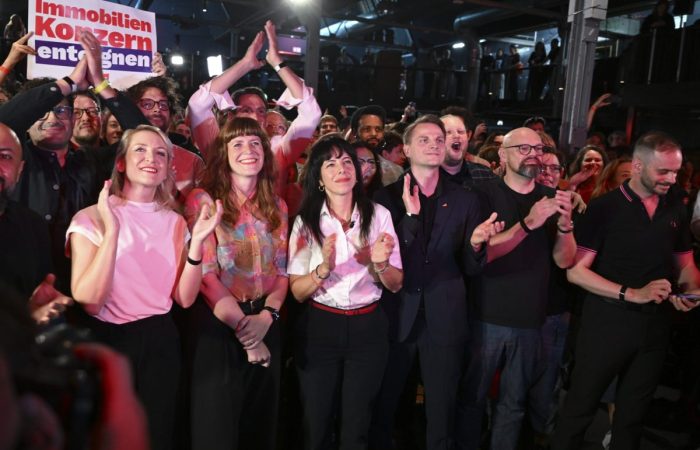
In the Berlin state elections held on 20 September, Die Linke (The Left) emerged as the leading party, securing 25.7% of the vote. Crucial to this victory was the mobilisation of young voters, previous non-voters, and German citizens of immigrant background. While the far-right Alternative for Germany (AfD) continues its ascent in eastern Germany, Die Linke outperformed expectations in both the state parliament and mayoral races, having polled at around 22% in the final stretch of the campaign.
Despite some of its own supporters harbouring doubts about entering the local government, Die Linke more than doubled its share of the vote compared to the previous election. The Christian Democratic Union (CDU), which currently holds the mayoralty and had been projected at 21% in opinion polls, finished in second place.
The atmosphere in the final run-up to the vote was defined by the contest between Die Linke and the CDU. Ultimately, the CDU dropped 9.5 percentage points relative to the last election, stalling at 18.8%. In third place, the AfD gained 7.2 points to reach 16.3%—its highest result in Berlin to date.
Yet, unlike in other recent state elections, the AfD failed to double its vote in the capital. The Greens slipped to fourth place on 14.3%, while the Social Democratic Party (SPD) fell to fifth with 12.1%, both parties losing between four and six percentage points compared to the previous contest.
Youth, Former Non-Voters and Migrant-origin Communities
The support of young voters was decisive in Die Linke’s victory. For the first time in these elections, 16- and 17-year-olds were eligible to vote. Within the 16–24 age bracket, 47% cast their ballots for Die Linke. In this group, the Greens finished a distant second with just 11%, while the AfD garnered 10%, the SPD 9%, and the CDU 8%.
In the 25–34 age cohort, Die Linke captured nearly one in every two votes. To be sure, Berlin differs markedly from other German cities on account of its large youth population, high levels of education, professional diversity, cosmopolitan social fabric, and, above all, its historical affinity with the left.
Yet what proved even more critical to this victory was Die Linke’s ability to mobilise former non-voters. The party secured the votes of 75,000 citizens who had abstained in the 2023 election, thereby outperforming the AfD in this segment as well, the latter having drawn 65,000 previous non-voters.
By contrast, in the Saxony-Anhalt state elections held just two weeks prior to the Berlin vote, the AfD had owed much of its success to the backing of formerly disengaged electors. Furthermore, Die Linke succeeded in winning over 51,000 people who had voted Green in the previous election, alongside 37,000 former SPD voters.
The Berlin outcome demonstrates that non-voters do not inevitably drift towards the right. According to journalist Sebastian Friedrich, this segment of the electorate—a subject of intense debate in Germany given its strong mobilisation by the AfD—is far from socially or politically homogeneous. It comprises chronic non-voters, citizens disillusioned with the parties they previously supported, and youth. Low-income households and socio-economically precarious demographics are heavily represented within this group. Consequently, the crux of the matter lies in who can effectively address these voters’ demands, and into which political channel this accumulated disaffection is directed.
In Berlin, people of migrant background constituted a substantial share of those who had previously stayed away from the polling stations. By voting for Die Linke’s mayoral candidate, Elif Eralp, those who felt genuinely represented included not only electors of Turkish origin, but also voters from diverse migrant communities across the city. As Eralp underlined at the press conference held the morning after the election: “People who have lived here for decades are not foreigners; they are Berliners.” This statement can be read as the expression of a renewed political confidence and consciousness among Berliners with a history of migration.
The Rise of the Right Is Not Inevitable
Also in September, during regional elections held in two eastern German states—Saxony-Anhalt and Mecklenburg-Western Pomerania—the AfD succeeded in establishing itself as the main alternative to the federal government, the traditional parties, and the political status quo. These elections were largely shaped by the possibility of the AfD coming to power at the regional level. Voters for other parties, in fact, based their decisions largely on blocking a potential government led by the far right. Despite this, the AfD managed to finish first in both of these states.
This is a topic that deserves an article of its own. However, the analysis by East German sociologist and activist David Begrich on the AfD’s racist rhetoric proves particularly illuminating. According to Begrich, a large portion of the AfD’s electorate is fully aware that a government led by this party will not solve their economic difficulties. Nevertheless, even if their own situation does not improve, the prospect of a deterioration in the living conditions of “others”—such as people of immigrant origin, asylum seekers, and queer people—significantly bolsters the appeal of the far-right party. The erosion of social solidarity and the widespread feeling of “no alternative” in the face of multidimensional crises are among the main driving forces behind the radical right.
In Berlin, by contrast, political discontent has found expression in a politics grounded in social class and centered on concrete goals and demands, rather than stoking identity-based divisions. This dynamic shows that the rise of the right—made particularly striking by the election results in eastern Germany—is by no means inevitable.
A Class-Based Strategy
Die Linke focused on issues that directly impact the vast majority of Berlin’s population: soaring rents, exorbitant public transport fares, and the rising costs of food and access to sports facilities. The condition of the streets, seldom cleaned across many districts, alongside waste management problems, also featured prominently on the campaign agenda. Die Linke notably proposed establishing neighbourhood canteens to ensure universal access to affordable, nutritious meals. These demands were brought directly to the public through grassroots engagement methods, such as extensive door-to-door canvassing and a broadly participatory “tenants’ assembly”.
In an era of deepening polarisation, this class-based strategy was a thoroughly deliberate choice. Consequently, the acute housing crisis was placed at the very core of the campaign. As spiralling rents and the right to housing emerged as the central issues of the election, Die Linke adopted an unapologetically confrontational stance on the matter.
For instance, it made the implementation of the expropriation and socialisation of major corporate landlords—an initiative approved by a majority of Berliners in the referendum of 26 September 2021—a non-negotiable prerequisite for entering any future governing coalition. In doing so, Die Linke directly embraced one of the key social fault lines running through the city.
Furthermore, Die Linke’s electoral manifesto aims to halt increases in public transport fares, introduce free travel for school pupils and university students, and lower the monthly social transit ticket for low-income residents to nine euros.
Under the manifesto, admission to public swimming pools will be free for anyone under the age of 18. “Neighbourhood canteens” to be opened across every district will offer healthy meals starting at three euros. Within the first 100 days of taking office, rents across state-owned housing will be frozen for one year, after which annual rent increases will be capped at a maximum of 1%. Furthermore, Die Linke pledges to construct 7,500 new municipal social housing units each year and to raise taxes on luxury property.
The inspiration behind this electoral strategy is hardly a secret. Several party leaders travelled to examine firsthand the New York mayoral campaign of Zohran Mamdani. The slogan ‘Make Berlin affordable’ (Berlin bezahlbar machen) was a direct reflection of the ‘affordability’ campaign championed in New York by the Democratic Socialists of America (DSA).
The Impact of the Tenants’ Movement
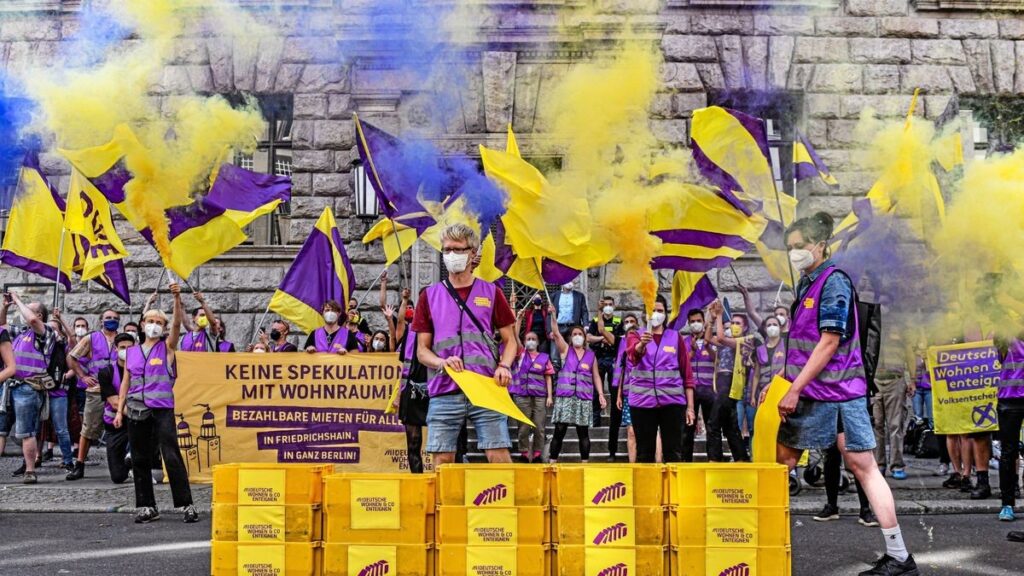
This electoral success cannot be understood without taking into account the city’s tenants’ movement, which has built robust grassroots organisation over many years. In the referendum held on 26 September 2021, 59.1% of Berlin voters backed the socialisation of major corporate landlords. Moreover, once foreign residents disenfranchised from voting are factored in, around 70 % of Berliners would have demanded expropriation.
The tenants’ organisations spearheading the “Deutsche Wohnen & Co. Enteignen” (DWE) campaign succeeded in transforming an alternative housing model—one that is affordable, shielded from market forces, and democratically administered—into a tangible policy solution endorsed by the overwhelming majority of the city’s population.
This triumph was the outcome of years of painstaking, sustained organising by the tenants’ movement. In April 2018, following a major rent protest that mobilised over 25,000 people, a new coalition emerged calling for the expropriation of Deutsche Wohnen, the city’s largest private landlord, alongside similar corporate property firms.
This coalition brought together Deutsche Wohnen tenants, housing rights organisations, and grassroots activists. Among the pioneers of the process was the Kotti & Co initiative, which had campaigned for years at Kottbusser Tor in Kreuzberg to demand the remunicipalisation of formerly public housing estates.
The bedrock of the campaign consisted of face-to-face conversations conducted through door-to-door canvassing, while meetings were organised as open, accessible assemblies. In this way, organisational knowledge and political awareness permeated the entire city. Close cooperation with local tenants’ initiatives and the formation of district-level neighbourhood teams were pivotal to the campaign. These networks mobilised thousands of activists and secured broad public backing for housing demands.
The legal foundation of the campaign rested on Article 15 of the German Basic Law, a provision that had never previously been invoked. This article permits the transfer of land and means of production into collective ownership in exchange for compensation. The approved referendum text stipulated transferring the holdings of private housing corporations owning more than 3,000 apartments in Berlin to a public-law body.
Through this measure, approximately 240,000 socialised apartments would be removed from market mechanisms. Rents across these properties would thus become regulated, while the public housing sector’s market share would double to 40%, a shift also expected to exert downward pressure across the private rental market.
One of the most inspiring dimensions of the campaign was that its objective was not mere municipal nationalisation, but genuine socialisation. The majority of the governing board of the independent public-law entity tasked with managing the housing stock was to comprise representatives of tenants’ associations and civil society organisations. Under this democratically governed institution, the statutes would explicitly prohibit future re-privatisation, and corporate landlords would be compensated at rates well below prevailing market value.
Housing was conceived not as a commodity or state-owned property, but as a shared social good. Indeed, had the housing stock been transferred directly to standard state-administered entities, tenants’ collective voice might have been curbed, management would risk becoming bureaucratic and hierarchical, and the properties would remain vulnerable to re-privatisation following changes of government.
However, the initiative put to the vote was not a legally binding statute, but an advisory resolution urging the Berlin Senate to take the necessary steps towards socialisation. The CDU-SPD coalition that subsequently took office chose a divergent path, merely passing a hollow framework law that functioned as an evasive palliative and failed to socialise a single flat.
Structural Transformation within Die Linke
The rapid transformation underway within Die Linke is starkly reflected in the composition of its membership. From 8,300 members in Berlin at the end of 2024, the party’s ranks swelled to over 19,000 by September 2026. In doing so during an election year, Die Linke surpassed the Greens to become the largest political party in Berlin by membership. A similar trend is evident across the country as a whole.
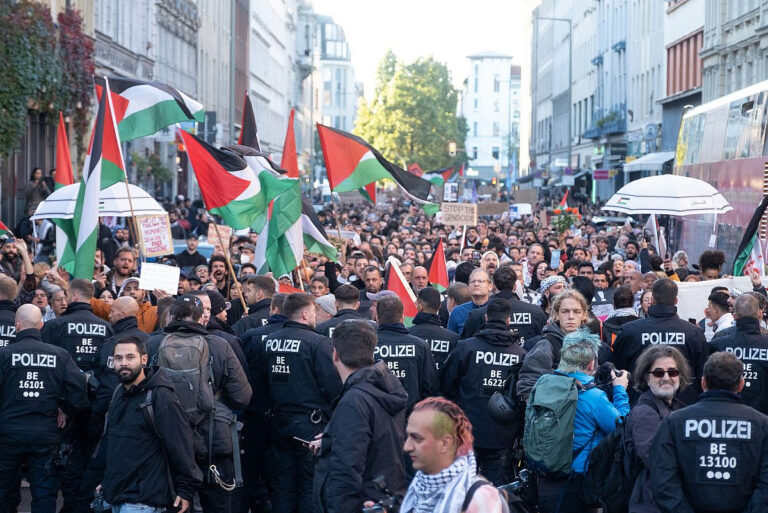
While the average age of party members exceeded 50 in 2023, it fell below 40 in 2026, providing Die Linke with the youngest membership profile among all parties represented in the Bundestag. The proportion of female members has risen by more than eight percentage points over the past five years, reaching 45.5%. A substantial share of these new recruits comprises young people politicised through demonstrations against the genocide in Palestine.
In southern Berlin, the working-class and migrant district of Neukölln, which has experienced rapid gentrification in recent years, saw its local branch emerge as a central protagonist of the party’s radical wing. In the September elections, Die Linke secured half of the vote in northern Neukölln, establishing a commanding lead over its rivals and winning three parliamentary seats.
The Example of Ferat Koçak
This success was no coincidence. In the February 2025 federal election, Ferat Koçak became the first candidate from Die Linke to be elected directly to parliament from a constituency within the former territory of West Germany. Born in Kreuzberg and raised in Neukölln, the 47-year-old Koçak—who has stood at the forefront of anti-racist and anti-fascist struggles since his early youth—describes himself as an “activist in parliament”. He remains one of the party figures closest to social movements. Elected from Neukölln, home to one of the largest Palestinian diaspora communities in Germany, Koçak was among the very first politicians to openly endorse calls for an immediate halt to arms exports to Israel.
Drawing heavily on the involvement of people of migrant background, Koçak’s campaign deployed a multilingual grassroots apparatus that visited nearly 100,000 households through door-to-door canvassing. While placing special emphasis on anti-fascism, the campaign foregrounded demands for affordable rents and social justice, alongside fierce criticism of police crackdowns on pro-Palestine demonstrations. The extensive engagement of grassroots activists and the mobilisation of local residents were integral to this breakthrough.
The Crisis Sparked by the Song ‘‘Stop the Genocide’’
On the other hand, just weeks before the Berlin elections, Neukölln also served as the stage for the most acute crisis of Die Linke’s campaign. During an election rally organised by the district branch under the slogan “Angry at Capitalism”, the Kurdish-Alevi rapper Dahabflex took to the stage to chant the lyrics of his track Stop the Genocide before thousands of attendees: “Yallah, yallah Intifada – West Bank, Palestine, Gaza / Death to the Israeli army”.
The incident triggered a widespread political storm across Berlin, placing accusations of anti-Semitism against Die Linke at the centre of the public agenda. The SPD, the CDU, and the Greens fiercely questioned Die Linke’s readiness to assume government responsibility. In opinion polls, the party’s voting intentions dipped by one to two percentage points for a brief period.
While Elif Eralp, Die Linke’s lead candidate for the Berlin governing mayoralty, condemned Dahabflex’s lyrics on the grounds that they ‘contained incitement to violence’, the Neukölln district branch came out in open support of the artist. Subsequently, the party’s regional executive convened for an extraordinary meeting and unanimously issued a statement rejecting all forms of violence.
Line of Tension: Government or Movement?
Die Linke won the Berlin elections under highly specific conditions. While the pressing housing crisis became the most defining issue of the campaign agenda, the genocide in Palestine sparked sharp polarisation, particularly in neighbourhoods such as Neukölln.
Before the election, a faction within the party actively opposed entering government. The primary rationale was Berlin’s colossal budget deficit. Within this wing, the prevailing view was that even if Die Linke were to secure the governing mayoralty, its fiscal room for manoeuvre would remain severely constrained. Factions close to social movements therefore established clear red lines regarding potential participation in government.
Chief among these were an unwavering refusal to abandon the expropriation of major housing conglomerates and a strict commitment that Die Linke would not become complicit in new social spending cuts. Resisting the authoritarian restructuring of the state apparatus and putting an immediate end to police violence directed especially against the Palestine solidarity movement were also among the demands voiced with particular force.
On the other hand, Die Linke’s vote share, which substantially outperformed expectations, weakened the standing of those within the party who viewed participation in government with scepticism. Consequently, the majority gave its approval to open coalition negotiations.
It is precisely at this juncture that a notable tension emerges. Social movements and the party’s radical wing, as vital constituent elements of Die Linke, were the primary architects of the Berlin breakthrough. Yet, should Die Linke enter a coalition with the Greens and the SPD, it will inevitably be compelled to compromise on numerous fronts.
Accordingly, one of the crucial questions to be answered in the period ahead is how relations between Die Linke in a potential coalition government and radical social movements will take shape. Given the substantial contingent of parliamentarians originating directly from social movements now sitting in the state assembly, the emergence of a fresh fault line between the imperatives of coalition-induced compromise and the oppositional stance maintained by these MPs would come as no surprise.
The Anti-Semitism Controversy and Berlin’s Jewish Community
Elif Eralp opened the election night celebrations with the words: “In our city, love and justice have triumphed over hatred.” Yet it would hardly be an exaggeration to describe the events of the days following the vote as an outburst of hostility directed against Die Linke.
The tone of the backlash was set on election night itself by AfD co-leader Alice Weidel. Denouncing a ‘deep-red alliance’, alleging that “Die Linke wants to put the rich against the wall and seize the assets of capitalists”, and decrying the perils of expropriation and rent caps, Weidel immediately targeted a potential Die Linke-led administration.
Journalist Ulf Poschardt, a staunch champion of liberal capitalism and a prominent columnist for the global media conglomerate Axel Springer, wrote: “Everyone fears 1933. Yet the real danger is 1949. East Germany (the German Democratic Republic) is returning, only this time harbouring Arab Islamofascists in its ranks.” Across mainstream media outlets, allegations that Die Linke’s Neukölln district branch had been infiltrated by Islamist and Stalinist elements proliferated unabated.
The backlash against Die Linke was by no means confined to the far right. The former chairman of the supervisory board of BlackRock Germany, current CDU leader and German Chancellor Friedrich Merz asserted that an increasingly radicalised and overtly expressed anti-Semitism had held sway in Berlin for months. Following Die Linke’s victory, the Israeli ambassador to Germany spoke of a “direct existential threat” confronting Berlin’s Jewish community. Meanwhile, the Minister-President of Bavaria, Markus Söder, threatened to exclude Berlin from the interstate fiscal equalisation scheme should Eralp assume the governing mayoralty.
According to sociologist Peter Ullrich, this controversy serves a highly tangible purpose: to weaken Die Linke, to pressure the SPD and the Greens against entering a coalition with it, or to compel the party to dilute its concrete demands during negotiations. Ullrich observes that accusations of anti-Semitism fulfil a strategic function in this process. However, he also underscores that the anti-Semitism debate is not merely a cynical political manoeuvre: when an assertion is repeated with sufficient frequency, people gradually come to believe it, generating a self-fulfilling collective delusion.
In Ullrich’s assessment, the claim that the election of Die Linke would render Berlin unsafe for Jewish people is entirely baseless. On the contrary, the party has passed unequivocal resolutions condemning anti-Semitism, and its leadership maintains an explicit stance on the issue. Furthermore, numerous Jewish leftists are active within its ranks. Ullrich points out that academic research consistently demonstrates that anti-Semitism is substantially more pervasive on the political right and declines progressively towards the left of the political spectrum.
At the same time, Ullrich emphasises that Die Linke continues to search for an internal consensus regarding the Israeli-Palestinian conflict and domestic anti-Semitism in Germany. Differing worldviews clash within the party: while certain currents place the plight of Palestinians at the centre of their politics, others prioritise combating the rise of anti-Semitism in Germany. In the German context, anti-Semitism is intrinsically bound up with questions of national identity and raison d’état (Staatsräson). Meanwhile, police repression, institutional curbs, stigmatising media coverage, and administrative bans have served to close ranks ever more tightly within the Palestine solidarity movement.
A few days after the election, more than 150 Jewish Berliners publicly rallied behind Die Linke through an open letter titled “For a Social and Safe City”, calling for a Left-Green-SPD coalition in the capital. The letter directly rebutted claims by the Central Council of Jews in Germany that Die Linke poses a threat to Jewish people and that its presence in government would constitute a security risk for Jewish communities.
According to the signatories, anti-Semitism becomes most dangerous when coupled with far-right ideology and anti-democratic tendencies. Relentlessly branding Die Linke as anti-Semitic constitutes a political instrumentalisation designed to conflate legitimate criticism of Israeli state policy with anti-Semitism. The letter reminds readers that Jewish families, like all Berlin residents, are equally affected by surging rents, precarious employment, overcrowded schools, an overstretched healthcare system, and deepening social segregation.
The Elif Eralp Factor
Poised to become Berlin’s first governing mayor of migrant background should she enter office, Elif Eralp maintains constructive relations with the city’s Jewish community. Combating anti-Semitism features prominently within the party’s manifesto. Compared to New York Mayor Zohran Mamdani, Eralp can be said to have adopted a visibly more measured tone regarding the genocide in Gaza.
While Mamdani speaks openly and bluntly on the matter, Eralp treads far more cautiously within Germany’s distinct political climate. Even so, she does not shy away from criticising the Israeli government or employing the term “genocide”. Furthermore, a formal resolution adopted at the party congress has officially entrenched the use of the term within the party’s institutional discourse.
Eralp was born in Munich on 14 January 1981. Her family had been forced to flee Turkey following the military coup of 12 September 1980, seeking asylum in West Germany. Raised in Hamburg, Eralp read law there, specialising in immigration law and human rights. From 2010 to 2021, she served as a legal policy advisor to Die Linke’s parliamentary group in the Bundestag. Anti-racism, combating discrimination, and housing policy have formed the core of her political work. She has served as a member of the Berlin State Parliament since 2021.
As the daughter of a political refugee family in Germany, Eralp’s personal and political trajectory aligns closely with the city’s pluralism. Today, Die Linke is arguably the party that best mirrors Berlin in all its social breadth. Although 42% of Berlin’s residents possess a migration background, these communities have historically been relegated to peripheral roles within the formal political system.
Eralp succeeded in uniting diverse communities behind her candidacy, reaching voters across broad swathes of the political spectrum, from conservatives to progressives. She gained traction within Sunni Muslim circles just as she did among Alevi and Kurdish communities. In the speech she delivered following the announcement of the results, she switched fluidly between German and Turkish. Addressing the hall in Kreuzberg, she championed a city where everyone’s voice is heard, “regardless of where they come from, what they believe, whom they love, or what their income may be”.
The “Post-Migrant” City
Emerging on the Berlin theatre scene in the late 2000s, the concept of the “post-migrant” (postmigrantisch) provides a vital lens through which to comprehend recent developments across the city. Pioneered by Shermin Langhoff at the Ballhaus Naunynstraße theatre in Kreuzberg, post-migrant theatre carved out an institutional space where artists of migrant background could articulate their own narratives in their own voices. Langhoff subsequently took the helm at the Maxim Gorki Theatre, enabling the concept to swiftly gain currency within academic discourse.
According to the analytical framework developed by scholars such as sociologist Naika Foroutan, migration in a post-migrant society is no longer an anomaly, but a structural reality shaping society in its entirety. This approach reads migration not through the prism of cultural difference or an alleged ‘integration problem’, but through the lens of wider social dynamics and structural conflicts.
These conflicts are understood as tensions between newcomers and their descendants—fighting to ensure that the constitutional promise of equality does not remain a dead letter—and those resisting demands for equal participation, recognition, and redistribution. The frontlines of this contest are constituted by concrete, material stakes: housing, education, employment, and political representation.
From this vantage point, the Berlin election can be interpreted as the political articulation of a post-migrant society. Electors of migrant origin mobilised not as external “foreigners”, but as Berliners directly confronting soaring rents, the rising cost of living, and socio-economic precarity.
The victory of Die Linke in Berlin rests upon three fundamental pillars. First, a coherent political line placing radical social policies at its centre. Second, organisational mobilisation coalescing around the genocide in Palestine. Third, the party’s capacity to genuinely mirror the pluralism of the city. The intense establishment backlash currently directed at Die Linke stems precisely from this tripartite orientation.
Taken together, these factors represent a counter-movement advancing social justice in direct opposition to the neoliberal, nationalist, and staunchly pro-Israel consensus prevailing across German politics. Cast against the shadow of the ascending far right, the prospect of a woman of migrant heritage bidding to govern one of Europe’s major capitals on a manifesto reminiscent of Mamdani’s carries profound significance. Berlin stands at a critical threshold. Whether this threshold can be crossed, and in what manner, will soon become clear.
Author’s Note
As this article was going to press, news broke that Die Linke, the SPD, and the Greens had signed a joint protocol on combating anti-Semitism, racism, and organised crime prior to commencing formal coalition talks. It was the SPD and the Greens who had made this protocol a non-negotiable precondition for entering negotiations.
Under the terms of the agreement, members of the party and its parliamentary group who violate the established principles could face expulsion. Die Linke’s regional co-chair, Kerstin Wolter, also declared that Israel’s right to exist was “non-negotiable”. Pushback from the party’s left wing followed swiftly. Approximately 120 politicians from Die Linke, including 17 members of the Bundestag and three newly elected Berlin state parliamentarians, issued a declaration titled: “Never Alone, Always Together! Against the Divisive Tactics of Springer and Co.”
According to the declaration, the protocol internalises the narrative promoted by weeks of hostile media campaigns and adopts a definition of anti-Semitism intended to silence all criticism of Israeli policies. The signatories argued that the SPD and the Greens were seeking to divide the party into “good” and “bad” leftists, writing that the Berlin negotiating team’s capitulation to this pressure constituted “a grave political blunder that must be corrected without delay”. In this manner, the fault line between governing and remaining a grassroots movement surfaced at the very outset of the coalition talks.
Auteur/autrice
-
İlker Ataç is Professor of Political Science in the Department of Social Work at Fulda University of Applied Sciences, Germany. His research focuses on migration and social policy, civil society organisations, the politics of social work, citizenship studies, and urban politics.
