
A Farewell to Arms or Yet Another Disillusionment? Contextualising the Kurdish Peace Process in Turkey
Alican TAYLA
12 mai 2026 This note was originally published on the website of the Institute for International and Strategic Affairs (IRIS) on 20 January 2026.
Marked by the PKK’s self-dissolution in May 2025, the latest phase in addressing the Kurdish issue in Turkey is shaped by a dual imperative: the domestic survival strategies of an authoritarian regime and regional realignments linked to the reconfiguration of the Syrian state. When contextualised within the broader history of the conflict and earlier, abortive attempts at political settlement, the underlying reasons for past stalemates become clearly discernible. Through an examination of the key stages and protagonists of the current initiative, the Turkish government’s strategic doctrine is critically appraised via the writings and declarations of its chief representatives. Given the persistent repression directed at the political opposition and the sharp line drawn between the “solution process” and future democratisation, the prevailing approach is exposed as fundamentally security-oriented rather than political—a stance that inevitably undermines the conditions required for a durable peace.
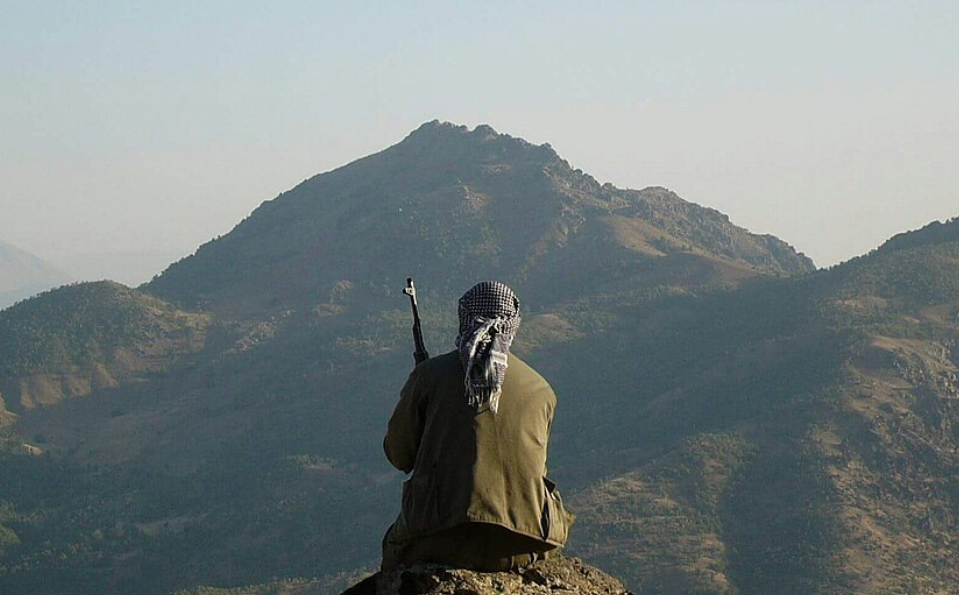
Kurdish combatant.
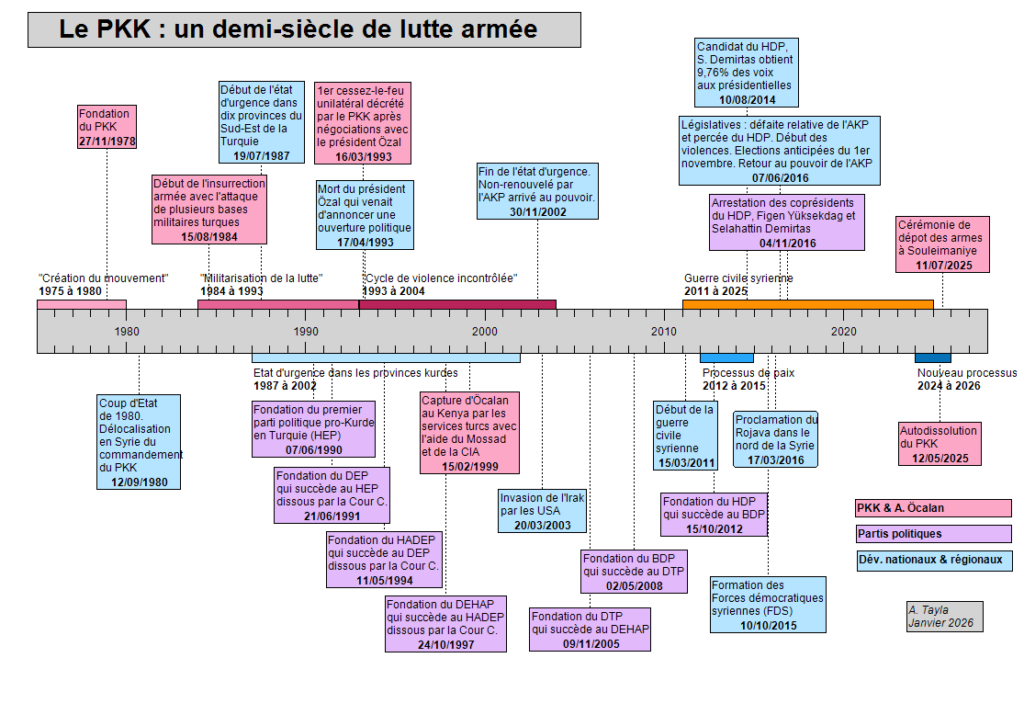
On 11 July 2025, near Sulaymaniyah in northeastern Iraqi Kurdistan, a symbolic PKK [Kurdistan Workers’ Party – Partiya Karkerên Kurdistan] arms-laying ceremony took place, during which around thirty militants threw their weapons into the flames on camera. Forty-one years after the start of the armed insurgency, triggered by two attacks on 15 August 1984 in the provinces of Hakkari and Siirt in southeastern Turkey, the low-intensity conflict between the Turkish army and the organisation founded by Abdullah Öcalan had persisted, despite successive changes in government and the shifting strategic landscape of the region. With more than 40,000 deaths(1), several thousand villages evacuated or destroyed—resulting in the forced displacement of more than three million civilians according to official Turkish government figures(2)—as well as numerous cases of enforced disappearance and torture reported by NGOs(3), this is one of the longest-running conflicts in the Middle East and, without a doubt, the central issue around which Turkish domestic politics have revolved for four decades.
While Recep Tayyip Erdoğan’s regime has been shifting toward authoritarianism since the early 2010s, against the backdrop of an extremely tense regional situation, this shift in the “Kurdish question” seemed unexpected, to say the least. The development was all the more surprising given that the first steps toward what is now known as the “solution process” came from Erdoğan’s ultranationalist ally, Devlet Bahçeli, leader of the MHP [Milliyetçi Hareket Partisi – Nationalist Movement Party]. Indeed, it was he—a staunch advocate of the hardest line against the Kurdish movement—who, in October 2024, shook hands with deputies from the pro-Kurdish DEM [Halkların Eşitlik ve Demokrasi Partisi – Peoples’ Equality and Democracy Party], revealed the existence of discussions between Öcalan and Turkish intelligence services, and raised, in a speech, the possibility that the PKK leader—imprisoned in İmralı prison since his capture in February 1999—might come to address the National Assembly.
Events unfolded at an unusual pace following Bahçeli’s initial statements: on 27 February 2025, Öcalan called for the dissolution of the PKK and the demilitarisation of all armed Kurdish groups in the region(4). Less than three months later, following its congress held from 5 to 7 May, the organisation announced in an official statement released on 12 May that it had decided to disband and end the armed struggle(5). In early August, a few weeks after the arms-laying ceremony, a parliamentary commission set up to manage the institutional side of the process began its work.
As expected, this swift opening phase soon gave way to a slowdown, although it is still too early to speak of a real deadlock. However, in the months after this succession of major events, a great many criticisms, concerns and questions have arisen regarding the process initiated by the Turkish state, most of them questioning the lack of reciprocity in the concessions, as the government appears increasingly reluctant to make tangible political progress.
But before examining the current process itself, it is essential to outline the broader context in which it unfolds and set it against its historical background, so as to grasp the full dynamics of this potentially decisive period in Turkey’s recent political history.
The Evolution of Öcalan’s and the PKK’s Positions on the Armed Struggle
F
irst, while the PKK’s decision to heed Öcalan’s call and agree to lay down its arms may seem sudden and unexpected, it actually reflects a gradual evolution in its leader’s ideology and vision. This trajectory can be traced both in Öcalan’s statements over the years and in the PKK’s actions.
Founded in 1978 and having launched its armed insurgency in 1984, the PKK saw its demands and methods gradually evolve over the decades. In a 1992 interview, Öcalan explained his view of the legitimacy of armed resistance as follows: “When nothing else can save humanity, when no option other than armed struggle can bring about normal, national, political, or social progress, only then can armed struggle be accepted. Apart from that, nothing else can justify armed struggle(6).”
In fact, the shift in the ideological position of Öcalan and the PKK on the question of armed struggle—now deemed ill-suited to the Kurdish cause in Turkey—is reflected concretely in the multiple unilateral ceasefires declared by the organisation since the 1990s.
The first ceasefire was declared in March 1993, on the initiative of President Özal, but lasted only a few months before collapsing following his death on 17 April 1993(7). On the eve of the parliamentary elections of 25 December 1995, a new ceasefire was announced, only to end in the summer of 1996. Another phase began in 1998, as Öcalan was hunted down, expelled from Syria under pressure from Ankara, and finally captured in February 1999. Shortly after his arrest, the PKK announced a new cessation of hostilities that lasted until June 2004. In 2006, the organisation once again declared a ceasefire, which was quickly rejected by the Turkish government(8). Finally, as part of the “peace process” initiated between 2013 and 2015, a ceasefire was established and accompanied by a partial withdrawal of PKK armed forces to northern Iraq. Having begun in May 2013, this withdrawal was nevertheless suspended a few months later, as the negotiation process gradually unravelled.
Abandoning independence in favour of democratic confederalism
T
hroughout this period, the PKK’s demands shifted significantly. As early as the 1990s, the organisation had abandoned the goal of an independent state. Under Öcalan’s leadership, particularly after his imprisonment, the idea of “democratic confederalism” developed, influenced by the writings of the American socialist philosopher Murray Bookchin, across the four countries where Kurds primarily live (Turkey, Iraq, Syria, and Iran)(9).
Alongside the multiple unilateral ceasefires, the central demand has thus shifted towards securing cultural rights—primarily the use and teaching of the Kurdish language—and political autonomy, based on a democratic transformation of the states concerned. It is in this context that Kurdish political parties, more specifically the pro-Kurdish socialist left-wing groups, entered the political arena. However, they were frequently subjected to state repression. These parties were repeatedly dissolved and re-established under different names throughout the 1990s and 2000s. Despite the evolution of the Kurdish movement’s demands and methods, the Turkish state’s position remained largely unchanged. Indeed: “From the Turkish state’s perspective, the Kurdish demands advanced by the PKK were, as early as the 1990s, recoded in the language of security as a threat of ‘separatist terrorism,’ replacing the earlier discourse on ‘anarchy.’ This shift in discourse enabled a more systematic and legally regulated repression(10).”
Thus, the declaration of 27 February 2025, reflects a renewed commitment to abandoning armed struggle in favour of a political resolution to the Kurdish conflict in Turkey.
Over this long period of tension and armed struggle, punctuated by unsuccessful rounds of negotiation, two episodes deserve special attention, as they undoubtedly had a decisive impact on the conflict as a whole. These were also the two moments when a lasting solution to the “Kurdish question” seemed particularly feasible. It is therefore essential to examine the factors that made these dynamics possible, as well as the reasons for their failure, if we are to understand the ongoing process and assess its prospects for success.
The 1993 process: A failure clouded by uncertainty
T
he year 1993 marked a real turning point in the Kurdish question in Turkey. For the first time since the early 1980s, a credible political resolution seemed to be taking shape thanks to the opening initiated by President Turgut Özal. His unprecedented approach—cultural recognition, dialogue with the PKK and a rapprochement with the Kurds of Iraq—created the conditions for profound change. On 16 March 1993, this favourable climate culminated in Öcalan’s announcement of a unilateral ceasefire, in the presence of Jalal Talabani, president of the Kurdistan Regional Government (KRG). This episode marked a strategic shift from separatism towards political demands within Turkey. Özal was then preparing a package of reforms to present to the National Security Council [Millî Güvenlik Kurulu – MGK], opening a historic sequence aimed at a political settlement.
However, this fragile momentum was quickly undermined by a series of events that remain controversial to this day. On 17 April, came the sudden death of Turgut Özal. Officially attributed to a heart attack, his death nevertheless sparked persistent suspicions of poisoning. These suspicions were reinforced by inconsistencies in the medical care he received, accusations from his family and close entourage, the exhumation of his body in 2012 and the lack of definitive forensic conclusions(11). A few weeks later, on 24 May 1993, the execution of 33 Turkish soldiers in Bingöl by a PKK unit led by Şemdin Sakık—carried out without the approval of Öcalan or the central committee—caused a major shock and shattered the credibility of the ceasefire. Years later, Sakık, who had become a witness in the Ergenekon trials, claimed that the Turkish army was aware of his planned attack and had deliberately chosen not to intervene(12). In any case, on 8 June, Öcalan declared an end to the ceasefire and the Turkish army launched intensive operations against PKK forces that would last several months.
Alongside Özal’s death and the accumulation of these violent events came an abrupt shift in policy. The process pivoted towards a hardline security approach when the Çiller government adopted the “Fortress Plan” [Kale Planı], based on large-scale military repression and the abandonment of negotiations. This marked the beginning of a phase of sharply escalating violence in the 1990s(13).
The Oslo talks and the 2013–2015 process against the backdrop of an authoritarian turn
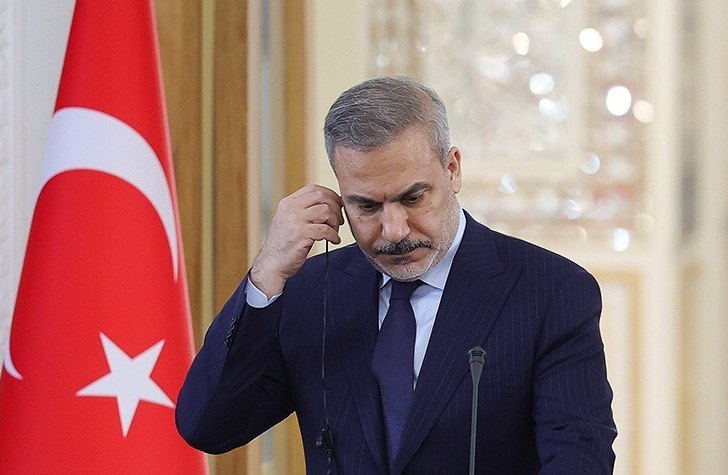
Twenty years later, in 2013, a new peace process was initiated by the AKP [Adalet ve Kalkınma Partisi – Justice and Development Party]. This was in fact a continuation of the secret talks held between the Turkish intelligence service MİT [Millî İstihbarat Teşkilatı – National Intelligence Organisation], led by Hakan Fidan—the current Minister of Foreign Affairs—and representatives of the PKK. Begun in 2008 and known as the “Oslo process”, these talks were leaked to the media in 2011, sparking a political crisis in Turkey. This revelation prompted an attempt to prosecute Fidan. The executive had to intervene by passing a law (No. 6278 of 2012) requiring the Prime Minister’s approval for any prosecution of MİT personnel(14). As for the prosecutor who had sought to bring charges against him, he was, a few years later, tried and sentenced to eleven years’ imprisonment for membership of FETÖ [Fethullahçı Terör Örgütü – Fethullah Terrorist Organisation], designated as a terrorist organisation by the Turkish government(15).
The new peace process was politically launched during the Newroz celebrations on 21 March 2013 in Diyarbakır, with the public reading of a letter from Abdullah Öcalan. In it, the imprisoned PKK leader openly called for an end to the armed struggle and declared that “the time had come for armed militants to move to the other side of the border(16).” The culmination of this process was the Dolmabahçe meeting on 28 February 2015 between representatives of Ahmet Davutoğlu’s government and a parliamentary delegation from the HDP [Halkların Demokratik Partisi – Peoples’ Democratic Party], known as the “İmralı delegation” because it conveyed the messages of Öcalan, whom it visited repeatedly in prison. A joint statement issued following this meeting set out ten key points outlining a roadmap towards lasting peace. These ten points provided, on the one hand, for constitutional reforms guaranteeing the pluralistic recognition of all identities, the strengthening of local democracy and autonomy, and individual rights and freedoms, and, on the other hand, for the gradual disarmament of the PKK(17). While the HDP welcomed this “Dolmabahçe Consensus”, government representatives, led by Erdoğan, soon distanced themselves from these announcements, which were not followed by any concrete action(18).
Two main factors explain the failure of this process: one internal, the other regional. On the regional level, the Syrian civil war—particularly the siege of Kobane—placed Kurdish forces and Ankara on completely opposing sides. Domestically, following the violent repression of the Gezi movement (7 deaths, thousands of injuries and arrests), the major corruption revelations reaching the highest levels of the state (17–25 December 2013), and the breakdown of the alliance with the Gülenists, the regime entered an accelerated phase of authoritarianism, hardly compatible with a context of de-escalation on the Kurdish issue. Moreover, the negotiation process with the Kurdish movement became a marker of the regime’s evolution, with signs of tension and disagreement between Erdoğan himself and other government officials. In this sense, he did not hesitate to publicly disavow the Dolmabahçe meeting just one month later, declaring that he would not accept any of the ten points negotiated during those talks and categorically distancing himself from the peace process. It is worth recalling that this gradual transformation of the political sphere, shifting from a dominant-party regime to a concentration of power around the leader, did not meet with unanimous support within the AKP(19). The 2017 reform establishing a presidential system represented its decisive act. Prime Minister Ahmet Davutoğlu, the former strongman of the AKP, who had visibly fallen out of favour with the leader he had served as a special adviser before becoming Foreign Minister, was subsequently sidelined from power a few months later, before leaving the AKP and founding his own party, now in opposition.
What brought this period to a definitive end was the parliamentary elections of 7 June 2015. The results dealt the AKP its first (relative) electoral setback since 2002: Erdoğan’s party lost its absolute majority in the Assembly and was forced to consider a coalition government with certain opposition forces. Erdoğan’s response was then to thwart any attempt at a coalition(20) and to resume hostilities in the Kurdish regions(21). Thus, against a backdrop of severe instability, repression and controversy surrounding widespread electoral fraud, the snap elections of 1 November 2015 restored the AKP’s absolute majority—but with its power more isolated than ever(22). It was, moreover, in the wake of this political and electoral context that Erdoğan was forced to ally with the ultranationalists of the MHP, categorically closing the door on any hope of a peaceful resolution to the Kurdish conflict, which had once again become “a terrorism problem” in the jargon of the state and pro-government media. Indeed, the country entered another phase of heightened repression that particularly targeted elected HDP officials and intensified with the purges following the 15 July 2016 coup attempt. The regime immediately attributed the coup attempt to the Gülenist movement. Consequently, a dozen HDP MPs, including the party’s co-chairs Figen Yüksekdağ and Selahattin Demirtaş, and several dozen local elected officials were arrested(23). From August 2019, the government systematically dismissed the elected mayors of the largest Kurdish cities, replacing them with trustees [kayyum] appointed directly by the Ministry of the Interior.
A regional context marked by the reconfiguration of the Syrian state and Israel's wars
Five years later, this current process of negotiation and resolution of the Kurdish question in Turkey unfolds against a regional backdrop marked by major realignments, to which it is closely linked.
Indeed, Syria lies at the heart of developments involving all the key players in the process, starting with the Turkish government and the Kurds. Since the fall of Bashar al-Assad’s regime, brought to completion by Hayat Tahrir al-Sham’s (HTS) decisive offensive in late November–early December 2024, Syria has more than ever become the chessboard where Kurdish forces and Ankara collide. The priority of the Kurds, organised within the Syrian Democratic Forces (SDF), is to preserve the gains of their long struggle against Daesh and to maintain the autonomy of Rojava, which covers nearly a third of Syrian territory. It also concerns the integration of their armed forces into the centralised structures of the new regime. Ankara, for its part, seeks at all costs to prevent these autonomy projects, which it views as an existential threat. So much so that since the outbreak of the civil war in 2011, and more particularly since the proclamation of Rojava’s autonomy in 2014, Syria has become a major domestic political issue for the Erdoğan regime. Indeed, “the Kurdish question has been the main obstacle to Turkey’s democratisation since its founding in 1923. Rojava is now an integral part of this question. The desire to annihilate this region continued to shape Erdoğan’s Syria policy throughout the years 2015–2024, and went hand in hand with increased repression against the movement and, more generally, Kurdish society in Turkey itself(24).” Consequently, the Turkish government is attempting by all means to maintain a decisive role in the reconfiguration of the new Syrian state, where it controls a considerable swath of territory south of its border, through its own armed forces and various jihadist factions under its direct influence within the framework of the Syrian National Army(25).
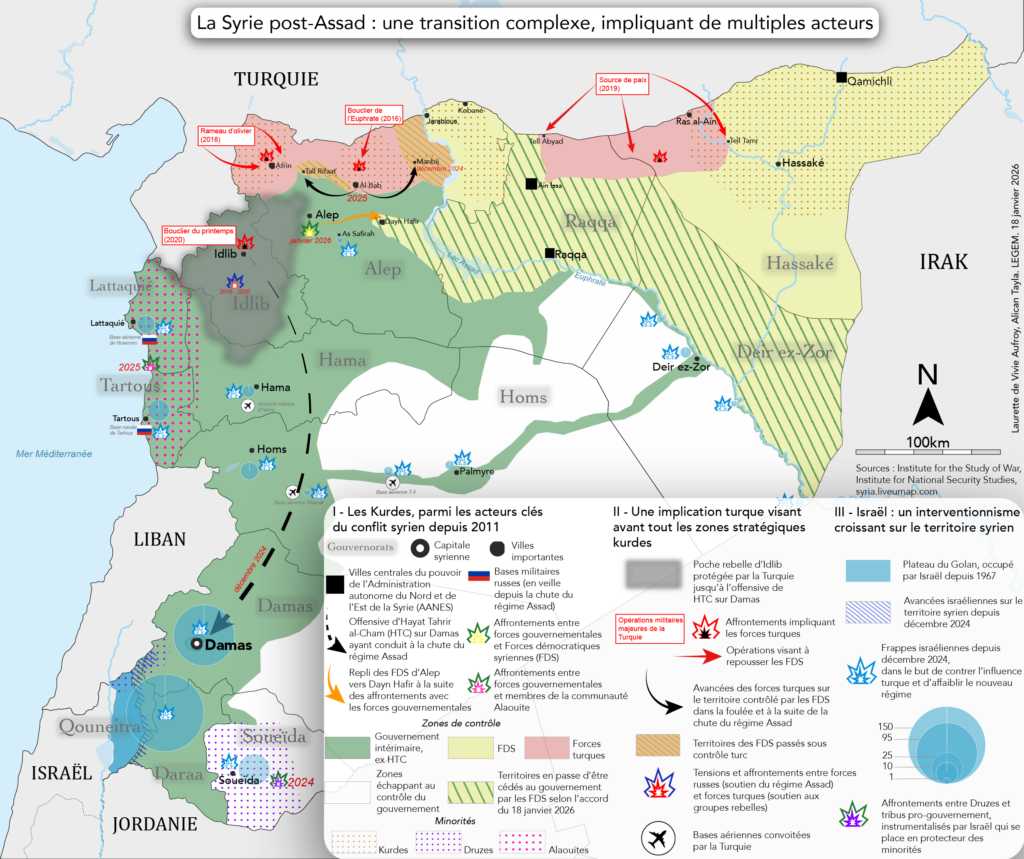
The United States under Donald Trump is, of course, playing a leading role in this transition phase for post-Assad Syria and its broader environment. Although President Trump’s previous term was marked by the controversial decision to withdraw from the country in October 2019—thereby abandoning the Kurds to their fate in the face of the imminent threat of impending Turkish operations—the United States is once again omnipresent in the strategic reconfiguration of the Middle East. This perfectly illustrates the major paradigm shifts that have taken place over the last five years. The Russia-Ukraine war has virtually neutralised Russia’s presence in the region and helped weaken the Baathist regime; Iran’s “Axis of Resistance” has been shattered by Israeli strikes; Bashar al-Assad’s regime has collapsed after fifteen years of civil war; and finally, Israel continues to carry out aggressive operations in the region, including committed in Gaza since 7 October 2023 that have been described as genocidal by several leading international NGOs (Amnesty International(26), Human Rights Watch(27)), United Nations bodies(28) and numerous genocide scholars(29).
All these major, closely linked events have intensified the already dense regional geopolitical realignments and repositioned Washington at the diplomatic junction between the key actors. Thus, the United States, still present in Syria—notably through its arming of Kurdish forces which it continues to support—is attempting to assume a mediating role in a multi-level game of interactions involving, on the one hand, relations between Rojava and Ankara, and between Rojava and Damascus, and, on the other hand, ties between Rojava and Iraqi Kurdistan.
To such an extent that Tom Barrack, the U.S. president’s special representative in the region, is now a central figure on the political scene in several countries, notably Türkiye. This billionaire, a real estate and finance magnate and longtime friend of Donald Trump—whose name has been mentioned in the Epstein case(30)—was appointed U.S. ambassador to Turkey in December 2024. Since then, despite being a novice diplomat, he has become a ubiquitous figure in the Middle East, also holding the posts of special envoy to Syria and Lebanon, where the United States does not have an embassy. In this capacity, he frequently makes public statements, in line with Trump’s unapologetic style, alternating between incentives and pressure. This sometimes lands him in hot water in a region with extremely complex and sensitive geopolitical stakes.
However, it is impossible to outline the regional context, let alone explain the US position, without mentioning the dominant ultra-aggressive actor that Israel has become in the Middle East. Enjoying near-total diplomatic immunity and unquestionably recognised as a major regional power—seeking even to become hegemonic—Tel Aviv and its expansionist policy alarm the Turkish government more than ever. Echoing a statement by Erdoğan to that effect, the Turkish media are increasingly claiming that, with Iran, Hezbollah, Hamas and Baathist Syria neutralised, Israel’s next target will be Turkey(31). Once again, Syria is the main chessboard on which the game is being played. Indeed, “Israel now regards Syria as its own hunting ground, presents itself as the protector of the Druze, officially acknowledges its relations with the Kurds in that country, and draws red lines for Turkey through a series of strategic bombings of the bases it covets(32).” In any case, for US strategy, regional developments are systematically assessed from the perspective of Israel’s security. The US approach to the Kurdish question, just like the negotiations regarding the future Syrian regime, is essentially conditioned by this priority. It is in this sense that Washington is pushing for a swift settlement—regardless of the terms—of the Turkish-Kurdish conflict. The process of resolving the Kurdish question in Turkey thus unfolds within a particularly dense regional context that is undergoing full-scale (re)construction.
For their part, the Kurds of Syria face a dual equation. On the one hand, should he possess sufficient political and coercive capacity, Ahmed al-Sharaa would undoubtedly favour the establishment of a centralised authority underpinned by an Arab-Sunni identity. On the other hand, the room for manoeuvre of all the actors involved is heavily conditioned by the Washington–Tel Aviv axis, which makes any large-scale Turkish intervention in northern Syria unlikely and, correspondingly, consolidates the SDF’s position in negotiations regarding the institutionalisation and official recognition of the gains secured on the ground. However, this constraint cannot be interpreted as a systematic alignment of Washington with Kurdish demands in Syria. The United States must also reckon with Turkey, for which this remains an issue perceived as existential.
Kurds in Syria and Kurds in Turkey: Distinct Yet Interdependent Dynamics
It would therefore be in the SDF’s interest to adopt a conciliatory stance towards Turkey so as not to stall any progress in negotiations with Damascus, and the path to such conciliation appears to run through “İmralı.” This is one of the essential links between the Kurdish processes in Turkey and Syria. It must also be emphasised that discussions between Damascus and Rojava are progressing very slowly, partly due to pressure from Ankara on HTS. The Turkish government’s desire to see the SDF diluted within a centralised regime naturally slows down the negotiations. That said, it would be naive to think that, without Turkish pressure, Ahmed al-Sharaa would be the first to yield to all the demands of the Autonomous Administration of North and East Syria (AANES—the official name of Rojava). Such a position would contradict both his ideological line (Sunni Islamism) and his project of establishing a centralised authoritarian regime. Thus, as Middle East expert Fehim Taştekin suggests, the strongman in Damascus is likely unperturbed by pressure from Ankara, which can serve as leverage in his own negotiations with the SDF(33). Indeed, if there is one point of convergence between Ankara and the new HTS regime, it is their opposition to the creation of a Kurdish autonomous zone in northern Syria. It is in this sense that the solution process in Turkey plays a central role within this equation.
First, the question arises of how to envision a policy of conciliation towards the Kurds of Turkey without abandoning the government’s plans to end Rojava’s autonomy. Or is it the acknowledgement of failure regarding this strategy on the Syrian front that is pushing Ankara to opt for a new approach, within which the solution process is situated? To answer these questions, we must look once again at Turkey’s domestic dynamics and internal actors.
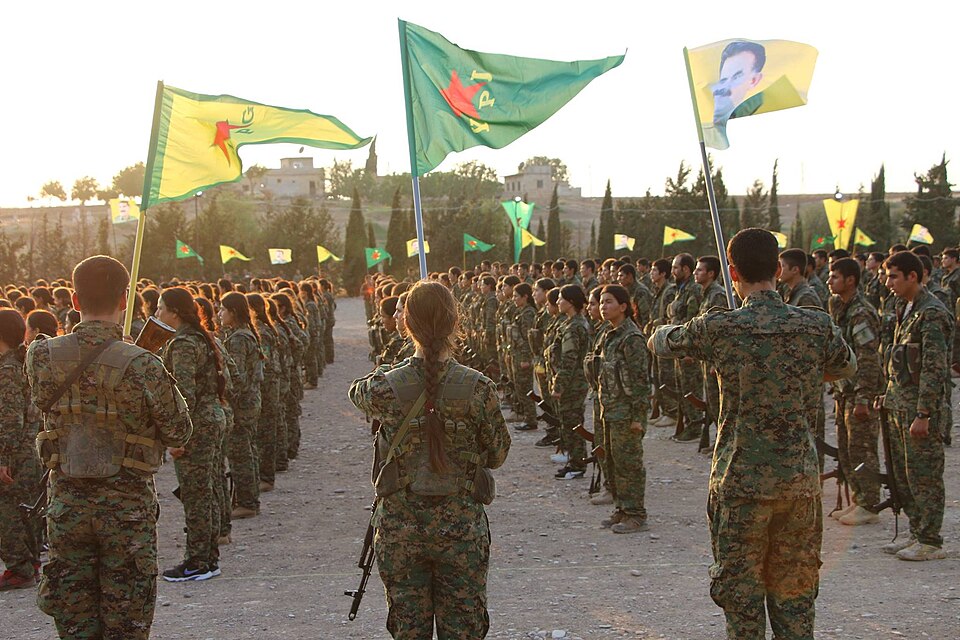
At first glance, the most striking element when examining the current process is undoubtedly the presence and role of Devlet Bahçeli, leader of the ultra-nationalist MHP, Erdoğan’s ally in the regime’s new configuration since the aborted coup of 2016. It may naturally seem puzzling that this historic figure of the hardest line towards the Kurdish movement has become the most prominent voice calling for a political solution. He now advocates direct negotiations with Abdullah Öcalan, “the founding leader(34)”, whom he had previously referred to as “the baby killer(35).”
What does Devlet Bahçeli stand for?
The process had indeed begun with his call on 22 October 2024 for Öcalan to come to Parliament to address the assembly(36). A year later, faced with a stalling process and the AKP’s electoral fears—with the party hesitating to participate in a parliamentary delegation travelling to İmralı to attend discussions with the PKK leader—it was Bahçeli once again who jolted those in power. He publicly pressured Erdoğan by declaring: “If necessary, I will go myself”(37). To make sense of this seemingly paradoxical initiative and this insistent enthusiasm, it is essential to pinpoint exactly what Bahçeli represents, beyond the political-media sphere.
A one-dimensional analysis of Devlet Bahçeli as a party leader, a minority electoral ally of the AKP, and a transparent actor on the political scene would be highly reductive and would obscure the underlying dynamics that drive Turkish politics. Indeed, he must be understood as representing—or claiming to represent—the interests of a state rationality, with pragmatism and political realism, in the name of immutable values that transcend partisan divides. This opaque dimension, of which different variations exist in every country, commonly referred to as the “deep state” in Turkey and likely not very different from what Öcalan recently termed the “normative state” with which he negotiates(38), has always determined the course of the “Kurdish question”. In this new phase we are witnessing, Bahçeli emerges as a political personification of an apparatus of raison d’Etat, in the Foucauldian sense, rather than as a mere partisan actor in the media-electoral sphere(39).
To assess the weight of Bahçeli’s words, one must not rely solely on his party’s electoral strength. Indeed, with 10% in the 2023 parliamentary elections and 6.5% in the 31 March 2024 municipal elections, the MHP appears to be a minority ally of the government. This last vote saw, for the first time, the CHP [Cumhuriyet Halk Partisi – Republican People’s Party] ahead of the AKP on a national scale. Yet when Bahçeli speaks—particularly on the “Kurdish question” over the past year—he is the spokesperson for an opaque faction surrounding the state apparatus rather than a popular movement. Beyond the current solution process, his alliance with Erdoğan—whom he fiercely opposed for nearly fifteen years—must be viewed within this framework and under the current configuration of Turkey’s political regime. Is Bahçeli the president’s saviour or his guardian? Undoubtedly both, as long as the interests of this faction require that the man who has led Turkey for nearly a quarter of a century remains in power.
The Crisis of Erdoğanism and the Paving of an Authoritarian Transition
Regarding the latter, signs that his reign is drawing to a close have been mounting for several years. The deep economic crisis into which the country plunged in the late 2010s has never been stemmed. At the same time, the political repression of the opposition continues and has now spread to the ranks of the CHP, the main opposition party. The democratically elected mayor of Istanbul, Ekrem İmamoğlu—presented as the main electoral threat to Erdoğan in the next presidential election—was imprisoned and administratively suspended from his post at the helm of Turkey’s largest city, an undemocratic practice that the regime has applied for years in many Kurdish cities, HDP strongholds. Finally, the AKP’s electoral erosion is becoming increasingly evident with each successive vote. This phenomenon is particularly striking at the local level: the AKP’s loss of mayoral control in five major cities—Istanbul, Ankara, Adana, Antalya and Mersin—in 2019 served as a first warning for the presidential party’s previously all-powerful local grassroots base. However, optimists within their ranks had hoped for a “renormalisation” of the situation in the subsequent municipal elections. The opposite occurred: in the municipal elections of 31 March 2024 (the most recent vote held in Turkey), the AKP not only failed to win back any of these cities but also lost others, such as Bursa and numerous urban districts considered its strongholds, such as Üsküdar in Istanbul(40).
At the outset of this process to resolve the Kurdish question—launched following the call by his main ally, Devlet Bahçeli—President Erdoğan finds himself in a political position more fragile than ever. This fragility weighs decisively on their respective stances regarding the Kurdish issue.
A Rift Within the State Faction?
It is true that since the beginning of the process, certain differences in stance, rhetoric, and, above all, zeal have emerged. To what extent do these differences stem from a tacit division of roles, centred around a shared political agenda? Or do they reflect substantial divergences between these two men and the blocs they embody? If so, which ones? It is essential to answer these questions to grasp the full dynamics of the current process.
Since the outbreak of the Syrian civil war, Erdoğan has feared that any strengthening of Rojava’s autonomy could set a dangerous precedent for Turkey. On the other hand, and in parallel, he hopes that a partnership or rapprochement with Öcalan would strengthen Ankara’s position vis-à-vis the Kurds of Syria. This hypothesis, while not entirely unfounded, nevertheless seems rather optimistic. In this sense, Öcalan’s call for “all components of the Kurdish armed struggle”—a phrase directly targeting the SDF—to lay down their arms, as well as the polite but categorical refusal by Mazloum Abdi, leader of the SDF(41), can be interpreted as telling signs. This is why the Turkish president clearly prefers to slow down the solution process, waiting to see how the question of Syria’s Kurds will initially be resolved. He appears to refuse any step towards the Kurds of Turkey within the framework of the ongoing negotiations until, on the Syrian front, he has obtained an outcome that meets Ankara’s demands. These demands, of course, centre on a vertical integration of the SDF into the new centralised regime in Damascus.
Now likely aware of the limitations of Öcalan’s powers of persuasion over the SDF, the Turkish government is turning to another major asset, one far more difficult to master: the United States under Donald Trump. Ankara hopes that US pressure on the SDF for a swift stabilisation of Syria will work in its favour. This is also why Turkey unequivocally supports the al-Sharaa regime.
It must also be added that, despite the repressive regime in place in Turkey, the AKP retains electoral concerns: the erosion of its voter pool is now affecting its own core base(42). Consequently, Erdoğan and his party fear the political and electoral consequences of any negotiation with Öcalan, which would be perceived as an act diametrically opposed to the ultranationalist rhetoric the government has adopted since the mid-2010s. Paradoxically, Bahçeli’s MHP, though traditionally anchored in a far more nationalist and hardline position towards the Kurds, is less troubled by such concerns: as a junior partner in power, it has less to lose from an electoral standpoint. Bahçeli’s entourage likely believes that, in a post-Erdoğan reconfiguration scenario, the unprecedented political cleavages that emerge will be little affected by his current stance.
The Syrian Chessboard and the Fear of Israel at the Heart of Political Calculations in Turkey
Between the two allies, the crux of the matter lies primarily in priorities and methods, rather than any divergence of objectives. Bahçeli, taking an approach that is more “statist” than political, unlike the AKP, prioritises Turkey’s domestic dynamics first, so as to then tackle the Syrian front on a stronger footing. More specifically, Bahçeli seems to fear that Israel will emerge as the primary protector of the Kurds of Syria, thus replacing the United States. To weaken the new central authority in Damascus, which Israel continues to perceive as a potential threat, Tel Aviv could seek to rely on various Syrian minorities—including the Kurds—which would also allow it to curb Iranian and, especially, Turkish influence in northern Syria. In this scheme, Bahçeli, who fears Israel more than Erdoğan does, also does not trust the United States to rein in the Syrian Kurds’ aspirations to autonomy.
This is undoubtedly the crucial juncture where Bahçeli’s and Öcalan’s visions intersect. The latter, in a meeting with the DEM delegation in his İmralı prison on 21 April 2025, stated: “Trump and Netanyahu are devising new plans for the Middle East under which Israel would be the hegemonic power in the region. They have a five-stage strategy, the first three of which have already been completed: Gaza, Lebanon, and Syria. Iran and Turkey remain. The Kurds occupy an essential place in this strategy. What is Israel’s plan for the Kurds? Israel’s only current concern regarding the Kurds is to eliminate me. Qandil [the current leadership of the PKK based in the Qandil Mountains] has no means of preventing these plans. Generally speaking, Qandil is under Iranian influence, and the SDF is under Israeli influence. I am the only one who can prevent this.” (43) In a context where Israel is openly courting the Kurds of Syria(44) and where the latter find themselves facing a strategic dilemma, Öcalan’s position can therefore appear to align with Bahçeli’s reading.
In any case, the external pressure from Turkey and Israel on Syria, with conflicting interests—a strong central regime that dilutes Kurdish autonomy demands for the former, and a weak, fragmented regime for the latter—considerably slows down the process of Syrian reconfiguration, confronting the Kurds with a particularly complex, multi-variable negotiating equation.
An Opaque and Asymmetrical Process from the Outset
From the outset of the process initiated in February 2025 with Öcalan’s call for disarmament, followed by the announcement of the PKK’s self-dissolution in May, the optimism of the movement’s historic leader raised several questions on a realpolitik level. While, as we have seen, the abandonment of the armed struggle does not constitute an unprecedented ideological break in the PKK’s trajectory, the political and strategic context in which this decision was taken could nevertheless appear hardly conducive to such a concession. On the one hand, the authoritarian hardening of the Turkish regime, combined with the electoral decline of the AKP; on the other hand, the unprecedented strategic advantages enjoyed by Kurdish forces on a regional scale—particularly in northern Syria, a major source of concern for Ankara—shaped a balance of forces that seemed, at first glance, favourable to Kurdish political actors in view of possible negotiations with the Turkish state. It was therefore difficult to foresee what underpinned Öcalan’s confidence that the talks could advance in an effective, fair, and democratic manner.
Less than a year later, this question remains, and concerns are mounting over the stalling of the process. The parliamentary commission “for national solidarity, fraternity and democracy”, established as early as 5 August 2025, is heavily criticised by opposition parties for its slow pace and undemocratic operation (45). But above all, in the face of concessions by the PKK, the Turkish government still appears unready to take concrete steps towards meeting DEM’s demands. One of its main demands is an amnesty and the release of countless Kurdish political prisoners. While a package of judicial reforms was presented by the government on 4 June 2025, it contained no provisions to that effect. The best-known cases remain those of Figen Yüksekdağ and Selahattin Demirtaş. The European Court of Human Rights ordered their release for the fourth time on 8 July 2025. However, on the following 18 July, the 22nd Criminal Court of Ankara once again rejected DEM’s request.
On the other hand, no significant progress has been observed regarding local democratic self-determination for Turkey’s Kurdish population, notably with the retention of a large number of kayyums in municipalities led by DEM. These administrators, appointed directly by the state in place of democratically elected mayors, were among the measures taken as part of the purges following the 15 July 15 2016 attempted coup(46). Since then, the use of kayyums has not only persisted but has also become systematic. Thus, after the municipal elections of March 2024, many mayoralties, including the major cities of Hakkari, Mardin, Batman, Dersim and Siirt, saw their elected DEM mayors dismissed from office and replaced by kayyums. Since 2016, the Turkish government has resorted to this practice nearly 150 times. The vast majority of these interventions have targeted HDP/DEM elected officials in Kurdish regions, based on allegations—often without final convictions and involving highly controversial procedures—of supporting terrorism(47). This mode of intervention constitutes a substantial impediment to democracy at both the local and national levels.
Furthermore, the use of kayyums is no longer limited to pro-Kurdish movements. Since the AKP’s defeat in the 2024 municipal elections, it has spread as far as the CHP. In addition to the dismissal and administrative replacement of several district-level elected officials, a court stripped Özgür Çelik of his position as head of the Istanbul CHP, appointing a former dissident from the same party in his place(48). Finally, on 19 March 2025, Ekrem İmamoğlu, Mayor of Istanbul, was imprisoned in connection with a corruption case(49).
Moreover, several representatives of the PKK and KCK [Koma Civakên Kurdistanê – Union of Communities of Kurdistan, an umbrella organisation encompassing several Kurdish groups internationally, all adhering to the ideological line and symbolic leadership of Abdullah Öcalan] have repeatedly affirmed that Turkey’s military operations against Kurdish positions have continued despite the announcement of the PKK’s dissolution, both in north-eastern Syria and in northern Iraq(50).
For the past year, the process has been labouring forward on this basis, in an almost total absence of transparency and any clear legal framework(51). However, it is undoubtedly the discrepancy in discourse that best summarises the diverging approaches between the two sides–the government on one side and pro-Kurdish actors on the other. It also helps explain the limited concrete progress on the part of the Turkish state. While DEM and other pro-Kurdish movements evoke a project for a “democratic Turkey”, the government, through the voice of its representatives as well as pro-government media, continues to deploy a vocabulary inherited from previous decades, systematically calling for a “Turkey without terrorism.”
Thus, “this asymmetry between Kurdish political initiative and the inertia of the Turkish state illustrates a profound impasse—epistemological, cultural and historical. The Turkish state, shaped by decades of nationalist rhetoric and the demonisation of Kurdish demands, remains paralysed by the idea of any recognition, however minimal, of the cultural or political rights of the Kurds. In this context, a resolution to the conflict seems contingent on a political will that is still absent, despite the historic opportunity that presents itself(52).” In other words, the government seems to favour a peace conceived as a maintenance of order within an authoritarian regime, rather than a genuine democratisation of Turkey, which was nonetheless made possible by the self-dissolution of the PKK and the abandonment of the armed struggle.
Discerning the Horizon
The context in which the next phase of the process will unfold is extremely fraught. It is therefore essential to clarify its main parameters in order to best discern the horizon lying ahead for Turkey.
In his foreign policy, Erdoğan is attempting a final bid for rapprochement—or reconciliation—with the West, particularly with the United States, even at the cost of irking his short-lived Russian ally. His regional policy, meanwhile, is likely to maintain the same red line: preventing the emergence of a heavily autonomous Kurdish entity on its borders. It will also pursue the same general objectives: consolidating Turkey’s status as an indispensable actor in the Middle East and securing a stake in Eastern Mediterranean energy dynamics.
However, the real fault lines may lie on the domestic front. The presidential election scheduled for 2028 appears extremely difficult for Erdoğan to win. On paper, he should be ineligible to run again and currently has no designated successor. Will the repressive line of attempting to prevent any credible opposition from launching a campaign be sufficient, or will it, on the contrary, backfire against a government already severely weakened at the ballot box? It is impossible to tell at this stage.
However, what is perhaps even more important than this electoral milestone is the stated ambition of the Erdoğan-Bahçeli bloc to draw up a new constitution before the end of the current presidential term. This project is presented as a “civilian constitution”, an allusion to the one drafted by the military junta and still in force since 1982, of which only about a third of the provisions remain unchanged. Despite repeated announcements and near-daily media debates about its content, there is officially no date for a public unveiling, no drafting committee and not even a provisional timetable. Preparatory work for the constitutional project does exist, but it is being conducted behind closed doors.
Yet it is already clear that the regime sees its constitutional ambitions as intrinsically linked to the process to resolve the Kurdish question, intending to ensure its own survival.
What the Writings of a Key Presidential Adviser Reveal About the Regime’s Strategy
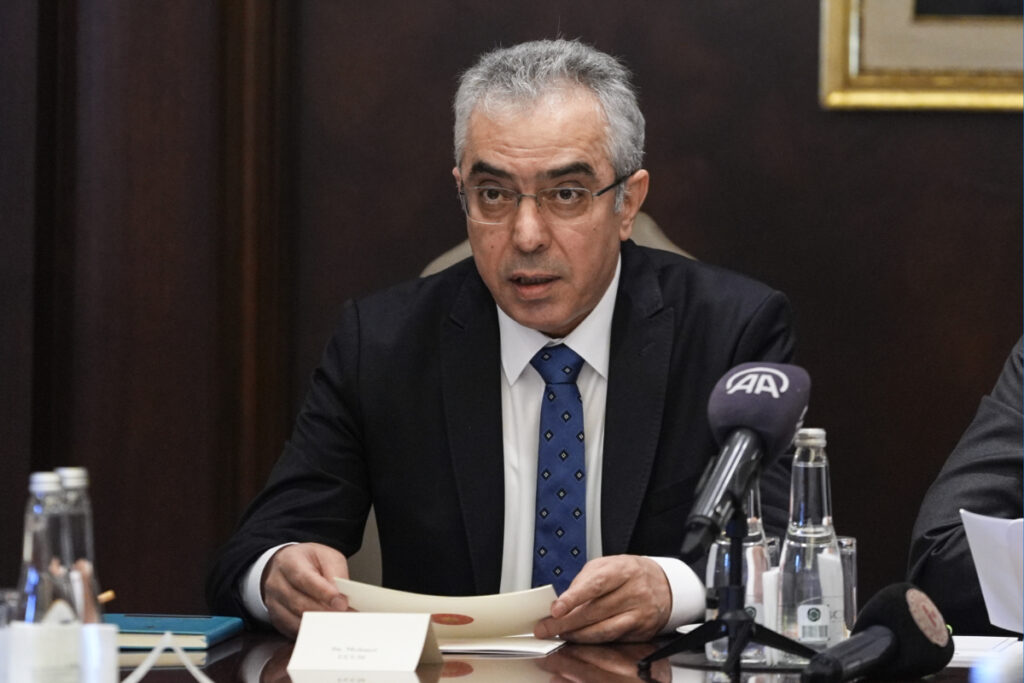
It is essential to grasp this perspective of the regime—both the expectations it invests in this process and what it hopes to derive from it—to evaluate hypotheses regarding its plausible trajectory. Recent writings by a key figure in the current period provide clear insight into the governing bloc’s vision. Namely, Mehmet Uçum, Chief Legal Adviser to the President of the Republic and the regime’s most prominent figure since the outset of the process, as well as one of the chief architects of the new constitution currently being drafted.
For several months now, this “palace insider” has been publishing regular articles on the website of the Anadolu Agency—the main public news agency and mouthpiece of the government—on two main topics: the process of resolving the Kurdish question and the preparation of the new Constitution. These successive columns, in the style of a blog, present us with both the thoughts of this former member of the Communist Party, who converted to Erdoğanism in the 2010s (and served as an AKP MP in 2015), and, through them, important indications of the governing bloc’s vision. As such, they also play a meticulously calculated role in preparing public opinion for upcoming measures, justifying them and articulating them through the regime’s filter. Naturally, there are many insights to be drawn from these writings.
Beyond a few indications as to the foundations of the Constitution in the making—which appears to be conceived on conservative, nationalist and authoritarian/centralising ideological grounds—three key elements emerge regarding the Kurdish process from Uçum’s perspective, and more broadly from ruling circles.
Distinction Between “Transition Process” and “Democratisation Process”
These three elements, directly linked to one another, paint a fairly clear picture of the Turkish government’s perception of the period of negotiations with the Kurds, as well as the narrative it seeks to project around the process.
First, with notable emphasis, Uçum categorically distinguishes between two things: “the transition process towards a Turkey without terrorism” (the name he gives to the ongoing negotiations) and “the process of democratic development” (which his texts primarily associate with the preparation of the new Constitution). On this point, there is a systematic effort to argue that the two must under no circumstances be confused or conflated. He writes, in particular: “This period, which prepares for the era of Turkey’s rise, comprises two distinct phases: the transition process [solution to the Kurdish question] and the process of democratic development. These two main phases must never be confused or intertwined. In other words, the ‘transition process towards a Turkey without terrorism’ and the ‘process of democratic development’ must imperatively be treated separately(53).”
Secondly, following from the first point, he argues that any attempt to insert democratic demands into the framework of the process to resolve the Kurdish question must be opposed. The latter is conceived solely in terms of an administrative management following the victory of the Turkish state, with the PKK’s decision to lay down its arms and self-dissolve. Thus, “from the point of view of its purpose, the ultimate goal of the transition process is to achieve a Turkey free of terrorism. Within this process of well-defined contours, there can be no question of taking into consideration all issues related to the development of democracy, nor all demands concerning the modalities of its implementation. […] The themes and demands associated with the democratisation process cannot be transformed into preconditions for the transition process, nor can they be pitted against it. Let it not be forgotten: the completion of the transition process will not constitute an end, but a beginning(54).”
Abdullah Öcalan: The State’s Exclusive Interlocutor
Finally, and thirdly, he articulates and justifies the governing bloc’s insistence on considering Öcalan as the sole representative of the Kurds within the framework of the process. This role of exclusive interlocutor, attributed to the PKK’s historic leader, imprisoned since 1999, fits as the logical extension of the two preceding points. In doing so, the aim is to reduce the question to a purely security dimension simply designed to put an end to terrorism. At the same time, such a framing amounts to excluding all other civil society actors, advocates of democracy and Kurdish rights, from the process.
Uçum explains this unambiguously: “The transition process is addressed neither to all the Kurds of Turkey nor to all the Kurds in the region. Consequently, there is absolutely no question of considering these actors as representatives of all Kurds, nor of speaking on behalf of all Kurds. The reverse is also true: in the process aimed at putting an end to terrorism and the politics of violence, it is not possible for representatives of other political spaces, outside of Öcalan and those who place themselves under his authority, to be elevated into actors of the process. In short, the plurality of Kurdish political representation can only come into play within the framework of the process of democratic development. It has no place in the transition process related to ending terrorism (55).”
In other words, and as he explains in several texts on the necessity of the Constitution, the process of resolving the Kurdish question does not follow a logic of democratisation; rather, it would serve as its prerequisite, conditioning any eventual future democratic advances.
The End of the Bicephalous Era of the Kurdish Movement in Turkey?
Since the capture and arrest of Abdullah Öcalan and the growing prominence of pro-Kurdish parties on the political scene, a de facto dual-headed and pluralistic configuration of the Kurdish movement has taken root in Turkey. On one side, the PKK with its command in Qandil and Öcalan from his prison in İmralı; on the other, the legal political party with its numerous MPs in Parliament, its local elected representatives, as well as the coalition of numerous associations and political formations gathered within the Peoples’ Democratic Congress [Halkların Demokratik Kongresi – HDK] and other civil society organisations in Turkey and in the diaspora. While it can be argued that both share the same overarching objectives and represent the expression of the will of Turkey’s Kurds across two distinct dimensions, it remains undeniable that, over time, divergences in approach, discourse and priorities have emerged between these two sets of actors.
The regime’s singular insistence on treating Öcalan as its sole interlocutor, within the framework of opaque exchanges, indicates a desire to reduce the Kurdish bloc to a single position, at least during this key phase of the demilitarisation of the struggle. To this end, the government skillfully relies on Öcalan’s genuine legitimacy in the eyes of the vast majority of Turkey’s Kurds(56). However, this profound legitimacy is of course not hegemonic in nature. Consequently, this cannot fail to weaken any alternative stance, including within the Kurdish movement itself, and especially those that would be more radical, more demanding and more constraining for the government.
In the short term, this also allows proponents of a “statist” reading of the process to discredit the democratic demands put forward by actors other than Öcalan. Uçum, once again, does not hesitate to write, for example: “While even Öcalan himself sets no other condition than the easing of his detention conditions, the fact that some go further and put forward more far-reaching demands can only be detrimental to the transition process. Öcalan’s constructive role in this process must be better understood(57).”
In the longer term, depending on the trajectory of the process set in motion a year ago, it remains to be seen how the role of Öcalan and the political party will evolve in a scenario–which is not yet entirely certain–of a definitive abandonment of the armed struggle.”
A Process That Conceals (or Reveals) the Contours of the Post-Erdoğan Project?
In light of all these elements, it is clear that the process to resolve the Kurdish question should not be read as contradictory to the repression that continues to target both the CHP and, persistently, the Kurdish movement itself. On the contrary, it appears to be fully integrated into the joint strategy of the Erdoğan-Bahçeli bloc, in a deliberate preparation for a new phase. In this upcoming phase, there would be little room for political plurality. The bulk of political affairs would be handled through direct negotiation with the centre of power, most often under opaque conditions, detached from popular grassroots and conducted with actors specifically designated as preferred interlocutors by the regime itself.
As it stands, the current process resembles a negotiation with Öcalan and the PKK based on symbolic and limited concessions, while taking great care to avoid any opening up a genuine process of democratisation. A revealing example concerns the prospective release of high-profile opposition figures who remain detained despite repeated rulings by the European Court of Human Rights (ECHR) demanding their release for several years. Beyond the case of Selahattin Demirtaş (imprisoned since November 2016) and other Kurdish political leaders, the most emblematic cases involve Osman Kavala (philanthropist and human rights defender, detained since 1 November 2017 in connection with the 2013 Gezi Park protests) and Can Atalay (Workers’ Party of Turkey MP, imprisoned since 25 April 2022). Even in the event of Demirtaş’s release, the regime would likely resort to legally complex procedures in order to prevent such a decision from setting a precedent that could apply to other cases. In this respect, it would reportedly consider an alternative legal basis, distinct from ECHR judgments, to authorise the release of the former HDP co-leader, whereas the cases of Kavala and Atalay do not fit into the logic of political transaction that the government seems to favour(58).
In Conclusion
In light of all these elements, it is clear that despite initial positive signs, the Turkish state is not yet ready to genuinely embrace a new vision of the Kurdish question. Indeed, its approach remains predominantly security-driven, and its determination to draw a sharp line between the resolution process and potential future democratic reforms is an unmistakable sign of this stance.
Attempts to link this question to short-term political calculations, whether relating to electoral timetables or Turkey’s Syrian policy, would prove counterproductive and severely undermine the prospects for a lasting and democratic peace.
The Kurdish question in Turkey is an eminently political issue. Its resolution can only be political as well, fitting inevitably into a broader process of democratisation that encompasses all of Turkish society in all its diversity. However, the current democratic deficit, exacerbated by years of AKP authoritarianism, makes any hope of gradual improvement through symbolic gestures or conciliatory rhetoric completely illusory. The unprecedented repression unleashed against the largest opposition party, precisely when Ankara is purportedly negotiating a democratic solution to the Kurdish question, perfectly exposes this illusion.
It remains to be seen whether the unilateral concessions made by the Kurdish forces will have the sole consequence of weakening the movement and offering Erdoğan a final political lifeline.
BIBLIOGRAPHY
[1] “Turkey’s Kurdish Conflict: 2015-Present”, Institute for Security & Development Policy. https://www.isdp.eu/publication/turkeys-kurdish-conflict-2015-present/
[2] https://edepot.wur.nl/647433
[3] https://www.hrw.org/sites/default/files/reports/TURKEY933.PDF ou https://www.amnesty.org.uk/human-rights-turkey
[4] Galle Tessonneau, Élise. “Appel d’Öcalan à la dissolution du PKK en Turquie : ce que l’on sait” https://www.france24.com/fr/moyen-orient/20250228-appel-d-%C3%B6calan-%C3%A0-la-dissolution-du-pkk-ce-que-l-on-sait
[5] “Le groupe militant kurde PKK annince son démantèlement”, Euronews https://fr.euronews.com/2025/05/12/turquie-le-pkk-annonce-sa-dissolution-et-la-fin-de-la-lutte-armee
[6] Abdullah Öcalan Şam Ham Röportajı | 1992 https://www.youtube.com/watch?v=yVVZ0A_3iuI&ab_channel=32.G%C3%BCn
[7] « La Turquie et le PKK, un conflit de trente ans », Le Monde, 21 mars 2013. https://www.lemonde.fr/europe/article/2013/03/21/la-turquie-et-le-pkk-un-conflit-de-trente-ans_1851516_3214.html
[8] « Le PKK décrète un cessez-le-feu unilatéral », Le Monde, 30 septembre 2006. https://www.lemonde.fr/europe/article/2006/09/30/le-pkk-decrete-un-cessez-le-feu-unilateral-a-partir-de-dimanche_818741_3214.html
[9] GERBER Vincent, « Les idéaux de Bookchin fleurissent au Rojava », EcoRev’, n° 44, janvier 2017, pp. 80-90. https://shs.cairn.info/revue-ecorev-2017-1-page-80?lang=fr#s1n4
[10] İNSEL Ahmet, interviewé par OUANDJELI Lyna, « L’évolution des relations entre le PKK et la Turquie », European Institute for Studies on the Middle East and North Africa (EISMENA), juin 2025. https://eismena.com/article/levolution-des-relations-entre-le-pkk-et-la-turquie-entretien-avec-ahmet-insel-2025-07-11
[11] “Mystery lingers over Turkish President Özal’s death 30 years on”, Daily Sabah avril 2023. https://www.dailysabah.com/politics/mystery-lingers-over-turkish-president-ozals-death-30-years-on/news
[12] “Secret witness reveals identity, shady ties between PKK and Ergenekon”, Today’s Zaman, novembre 2012. https://web.archive.org/web/20121106220050/http://todayszaman.com/news-297273-secret-witness-reveals-identity-shady-ties-between-pkk-and-ergenekon.html
[13] BOZARSLAN Hamit, « Human rights and the Kurdish issue in Turkey: 1984–1999 » [Droits humains et la question kurde en Turquie], Human Rights Review, 2001, vol. 3, n° 1, p. 45-54.
[14] “Turkey: Spy Agency Law Opens Door to Abuse”, Human Rights Watch, avril 2014. https://www.hrw.org/news/2014/04/29/turkey-spy-agency-law-opens-door-abuse
[15] “Profile: Hakan Fidan, Turkey’s long-serving intelligence chief, becomes foreign minister”, Bianet, juin 2023. https://bianet.org/haber/profile-hakan-fidan-turkey-s-long-serving-intelligence-chief-becomes-foreign-minister-279876
[16] “Kurdes, lettre ouverte à la paix”, Libération, mars 2013. https://www.liberation.fr/planete/2013/03/21/kurdes-lettre-ouverte-a-la-paix-en-turquie_890391/
[17] “HDP’li Pervin Buldan: 28 Şubat Dolmabahçe Mutabakatı’nın yıldönümüdür”, Independant Türkçe, février 2019. https://www.indyturk.com/node/17176/haber/hdp%E2%80%99li-pervin-buldan-28-%C5%9Fubat-dolmabah%C3%A7e-mutabakat%C4%B1n%C4%B1n-y%C4%B1ld%C3%B6n%C3%BCm%C3%BCd%C3%BCr
[18] “Erdoğan renounces Dolmabahçe declaration, says HDP should try its best for PKK’s disarmament”, juillet 2015, Daily Sabah. https://www.dailysabah.com/kurdish-issue/2015/07/17/erdogan-renounces-dolmabahce-declaration-says-hdp-should-try-its-best-for-pkks-disarmament
[19] TAYLA Alican, « La Turquie : le régime tout puissant de Recep Tayyip Erdogan », Multitudes, n° 63, février 2016, pp. 15-21. https://shs.cairn.info/revue-multitudes-2016-2-page-15?lang=fr
[20] “Erdogan “entrave” la formation d’une coalition”, Le Figaro, août 2015. https://www.lefigaro.fr/flash-actu/2015/08/03/97001-20150803FILWWW00068-erdogan-entrave-la-formation-d-une-coalition.php
[21] GAVERIAUX, Laura-Maï. “La sale guerre du président Erdoğan”, juillet 2016. https://www.monde-diplomatique.fr/2016/07/GAVERIAUX/55960
[22] ERDI, Gülçin. “Erdogan, le choc et les voix”, The Concersation, novembre 2015. https://theconversation.com/erdogan-le-choc-et-les-voix-50120
[23] BILLION, Didier. “Purge en Turquie : la stratégie autoritaire d’Erdogan”, Institut de relations internationales et stratégiques, novembre 2016. https://www.iris-france.org/83237-purge-en-turquie-la-strategie-autoritaire-derdogan/
[24] BOZARSLAN Hamit, « Le Rojava et la Syrie d’Ahmad al-Chaara », Telos, 2 octobre 2025. https://www.telos-eu.com/fr/politique-francaise-et-internationale/le-rojava-et-la-syrie-dahmad-al-chaara.html
[25] SAID, Ezzedine. “Les supplétifs syriens, fantassins de l’offensive turque en Syrie”, L’Orient-le Jour, octobre 2019. https://www.lorientlejour.com/article/1190586/les-suppletifs-syriens-fantassins-de-loffensive-turque-en-syrie.html
[26] “Une enquête d’Amnesty International conclut qu’Israël commet un génocide contre les Palestiniens et Palestiniennes à Gaza”, Amnesty International, décembre 2024. https://www.amnesty.fr/presse/enquete-amnesty-israel-commet-un-genocide-contre-les-palestiniens-a-gaza
[27] “Israel’s Crime of Extermination, Acts of Genocide in Gaza”, Human Rights Watch, décembre 2019. https://www.hrw.org/news/2024/12/19/israels-crime-extermination-acts-genocide-gaza
[28] Comité spécial des Nations Unies chargé d’enquêter sur les pratiques israéliennes : https://www.ohchr.org/fr/press-releases/2024/11/un-special-committee-finds-israels-warfare-methods-gaza-consistent-genocide ; Commission d’enquête internationale indépendante sur le territoire palestinien occupé, y compris Jérusalem-Est, et Israël (COI) : https://www.ohchr.org/en/press-releases/2025/09/israel-has-committed-genocide-gaza-strip-un-commission-finds ; Rapporteuse spéciale sur la situation des droits de l’homme dans les territoires palestiniens occupés depuis 1967 : https://reliefweb.int/report/occupied-palestinian-territory/anatomy-genocide-report-special-rapporteur-situation-human-rights-palestinian-territories-occupied-1967-francesca-albanese-ahrc5573-advance-unedited-version.
[29] Voir par exemple : GOLDBERG Amos, interviewé par LE BARS Stéphanie, « Ce qui se passe à Gaza est un génocide, car Gaza n’existe plus », Le Monde, 29 octobre 2024 https://www.lemonde.fr/idees/article/2024/10/29/amos-goldberg-historien-israelien-ce-qui-se-passe-a-gaza-est-un-genocide-car-gaza-n-existe-plus_6364702_3232.html ; VERDEJA Ernesto, « The Gaza Genocide in Five Crises » [Le génocide de Gaza en cinq crises], Journal of Genocide Research, 20 janvier 2025 – https://www.tandfonline.com/doi/full/10.1080/14623528.2025.2452707 ; SEGAL Raz, « A Textbook Case of Genocide » [Un cas d’école de génocide], Jewish Currents, 13 octobre 2023 – https://jewishcurrents.org/a-textbook-case-of-genocide.
[30] “US ambassador to Turkey named in newly released Epstein communications”, Bianet, novembre 2025. https://bianet.org/haber/us-ambassador-to-turkey-named-in-newly-released-epstein-communications-313542
[31] TAN, Altan, “İsrail’in asıl hedefi Türkiye ise…”, Independant Türkçe, octobre 2024. https://www.indyturk.com/node/746253/t%C3%BCrki%CC%87yeden-sesler/i%CC%87srailin-as%C4%B1l-hedefi-t%C3%BCrkiye-ise
[32] BOZARSLAN Hamit, op.cit.
[33] TAŞTEKİN Fehim, vidéo du 20 novembre 2025 : https://www.youtube.com/watch?v=GgwG-F3PQlM
[34] “Devlet Bahçeli’den “kurucu önder” ifadesine açıklama”, Nntv, octobre 2025. https://www.ntv.com.tr/turkiye/devlet-bahceliden-kurucu-onder-ifadesine-aciklama,DEJ-Dc2fik-mJcQvYX1ppA
[35] FATIH BEYAZ, Zafer. “MHP Genel Başkanı Bahçeli: Bebek katili Öcalan neyse Bağdadi ve hain Gülen aynısıdır”, Anadolu Ajansı, novembre 2019. https://www.aa.com.tr/tr/politika/mhp-genel-baskani-bahceli-bebek-katili-ocalan-neyse-bagdadi-ve-hain-gulen-aynisidir/1636220
[36] BOUKANDOURA, Raphaël. “En Turquie, le pouvoir prêt à discuter avec Abdullah Öcalan, le chef emprisonné de la guérilla kurde”, Ouest-France, octobre 2024. https://www.ouest-france.fr/monde/turquie/en-turquie-le-pouvoir-pret-a-discuter-avec-abdullah-oecalan-le-chef-emprisonne-de-la-guerilla-kurde-2917a290-9150-11ef-83a4-0ededa6d6967
[37] “Bahçeli’nin ‘Kimse gitmezse İmralı’ya ben giderim’ sözlerine tepkiler ne oldu?”, BBC Türkçe, novembre 2025. https://www.bbc.com/turkce/articles/cp3xvnrngk5o
[38] Mümtaz’er Türköne yazdı: Öcalan’ın muhatabı olan norm devlet; Amerika’nın lütfettiği meşruiyet”, Medyascope, septembre 2025. https://medyascope.tv/2025/09/27/mumtazer-turkone-yazdi-ocalanin-muhatabi-olan-norm-devlet-amerikanin-lutfettigi-mesruiyet/
[39] Sur la notion de raison d’Etat selon Michel Foucault, voir notamment : FOUCAULT Michel, Sécurité, Territoire, Population, Cours au Collège de France, 1977-1978, Seuil, 2004, 448 p.
[40] BOURCIER, Nicolas. “Elections municipales en Turquie : la large victoire de l’opposition constitue un désaveu cinglant pour le camp d’Erdogan”, Le Monde, avril 2024. https://www.lemonde.fr/international/article/2024/04/01/en-turquie-erdogan-essuie-un-desaveu-cinglant-avec-la-large-victoire-de-l-opposition-aux-municipales_6225298_3210.html
[41] “Syrie: le chef des forces kurdes salue l’appel d’Öcalan à la dissolution du PKK”, Institut kurde de Paris, février 2025. https://www.institutkurde.org/info/depeches/syrie-le-chef-des-forces-kurdes-salue-l-039-appel-d-039-ocalan-la-dissoluti-17765
[42] DOUGNAC, Marie. “En Turquie, le revers du parti du président Erdogan aux élections municipales”, Géoconfluences, mai 2024.https://geoconfluences.ens-lyon.fr/actualites/eclairage/elections-municipales-turquie-2024
[43] “Ruşen Çakır yazdı: Öcalan’ın İsrail ile, İsrail’in Öcalan ile ne alıp veremediği var?”, Medyascope, juin 2025. https://medyascope.tv/2025/06/15/rusen-cakir-yazdi-ocalanin-israil-ile-israilin-ocalan-ile-ne-alip-veremedigi-var/
[44] “Natural Allies”: Israel to Cultivate Kurdish, Druze Ties”, Foundation for defense of democracies, novembre 2024. https://www.fdd.org/analysis/2024/11/10/natural-allies-israel-to-cultivate-kurdish-druze-ties/
[45] “DEM Partisi’nden Kardeşlik ve Demokrasi Komisyonu’na Eleştiri”, Haberler, septembre 2025. https://www.haberler.com/politika/dem-partisi-nden-kardeslik-ve-demokrasi-komisyonu-na-elestiri-19028646-haberi/ ; https://www.bbc.com/turkce/articles/cz68x492ppno
[46] TUTKAL Serhat, « Trustees Instead of Elected Mayors: Authoritarian Neoliberalism and the Removal of Kurdish Mayors in Turkey » [Administrateurs à la place des maires élus : néolibéralisme autoritaire et limogeage des maires kurdes en Turquie], Nationalities Papers, vol. 50, n° 6, novembre 2022, pp. 1164-1186. Publication en ligne : Cambridge University Press, 31 août 2021. https://www.cambridge.org/core/journals/nationalities-papers/article/abs/trustees-instead-of-elected-mayors-authoritarian-neoliberalism-and-the-removal-of-kurdish-mayors-in-turkey/
[47] “Turkish government appoints 149 trustees to municipalities since 2016”, Duvar English, novembre 2024. https://www.duvarenglish.com/turkish-government-appoints-149-trustees-to-municipalities-since-2016-news-65204
[48] “Turquie : la justice révoque la direction à Istanbul du principal parti d’opposition”, Libération, septembre 2025. https://www.liberation.fr/international/turquie-la-justice-revoque-la-direction-a-istanbul-du-principal-parti-dopposition-20250902_MEQNLNZQL5HADA4ZT475WYJA6Q/
[49] “Ekrem Imamoglu, le maire d’Istanbul en prison depuis le mois de mars, risque jusqu’à 2 340 ans de prison”, Le Monde, novembre 2025. https://www.lemonde.fr/international/article/2025/11/11/en-turquie-le-maire-d-istanbul-poursuivi-pour-142-infractions_6653014_3210.html
[50] “PKK rejects ‘exile’ of its members from Turkey after agreeing to disband”, France 24, mai 2025. https://www.france24.com/en/middle-east/20250520-pkk-rejects-exile-of-its-members-from-turkey-after-disarmament
[51] Pour une critique détaillée de la forme et du fond du processus et des travaux de la Commission, voir par exemple cette déclaration co-signée par trois ONG dont Human Rights Watch : https://www.hrw.org/news/2025/11/06/advancing-human-rights-justice-and-democracy-for-kurds-and-all-other-communities-in?utm
[52] İNSEL Ahmet, op. cit.
[53] UÇUM Mehmet, « Terörsüz Türkiye’ye geçiş ve demokrasiyi geliştirme süreçlerinin dinamikleri » [Les dynamiques des processus de transition vers une Turquie sans terrorisme et de développement de la démocratie], AA, 12 octobre 2025.
[54] Ibid.
[55] Ibid.
[56] “Öcalan, l’icône kurde, de la guerre à la paix”, France 24, mai 2025. https://www.france24.com/fr/info-en-continu/20250512-%C3%B6calan-l-ic%C3%B4ne-kurde-de-la-guerre-%C3%A0-la-paix
[57] UÇUM Mehmet, op. cit.
[58] “İddia: Demirtaş’ın tahliyesi için AİHM kararı baz alınmayacak”, Medyascope, novembre 2025. https://medyascope.tv/2025/11/16/iddia-selahattin-demirtas-in-tahliyesi-icin-aihm-karari-baz-alinmayacak/
