
Migration crisis and violent riots in Ceuta: The “European fortress” under siege, or a deliberate Moroccan strategy?
Salomée LANGUILLE
30th of September 2026
On Friday, July 31, 2026, Spanish Socialist Prime Minister Pedro Sánchez sounded the alarm: Spain had suffered an “attack” and a “violation of [its] territorial integrity[1].” On social media, the leader of the opposition (People’s Party), Alberto Núñez Feijóo, denounced a full-fledged “invasion[2] .” Europe is shaken, and Giorgia Meloni declares herself ready to “suspend the Schengen Area with Spain” in the face of the “threat[3].” At the root of this upheaval lies an issue that dominates public and institutional discourse across European Union member states: irregular immigration. On the night before the Spanish prime minister’s address, nearly 72,000 people swam across the border separating northern Morocco from the enclave of Ceuta illegally. Some Moroccan NGOs report the deaths of more than 141 people[4], many of whom drowned. But at the heart of the debates sparked by this event, the motivations, journeys, and fates of the people in this crowd are overshadowed by one question: How was such a large group able to cross a border crossing that is so tightly sealed off and heavily guarded—a crossing on which the EU has focused its attention for decades? While this incident occurs against a backdrop of increased cooperation between Spain and Morocco on the issue of migration, geopolitical strategies are taking shape behind the scenes.
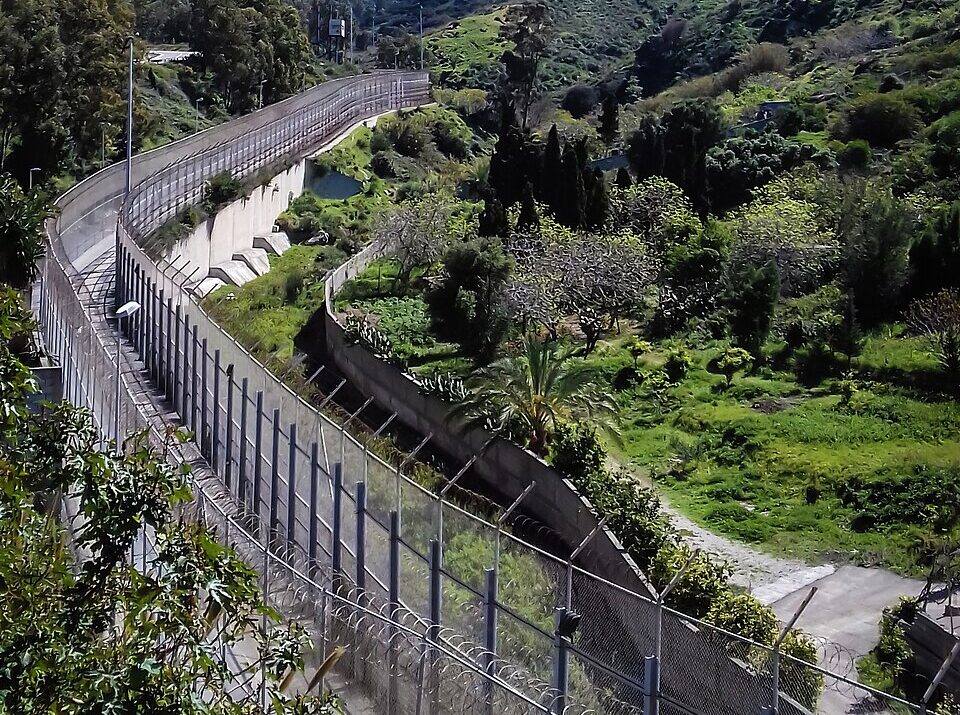
Barbed-wire and surveiled fence marking the border between Morocco and the Spanish enclave of Ceuta
Located at the northern tip of Moroccan territory, the autonomous city of Ceuta covers 19 km² and occupies a strategic position as a Mediterranean bridge to Europe. Just 14 km from the Andalusian coast, it is thus a key crossing point for people seeking to leave Morocco for Spain or traveling through North Africa. Consequently, it has gradually been transformed into a “fortress[5]” in service of the policy of externalizing Europe’s borders. Originally under Portuguese rule, it came under Spanish control in 1580 during the unification of the neighboring kingdoms by Philip II. When this agreement came to an end nearly a century later, Ceuta remained part of Spain following a plebiscite, much to the chagrin of the Cherifian Empire. Even today, Morocco refuses to recognize Spanish sovereignty over this enclave, as well as over that of Melilla, further to the east, and relentlessly demands the return of the “occupied northern cities.”[6] Despite protests from the other side of the Mediterranean, successive Spanish governments have worked to build and consolidate this unique European border on the African continent. This effort came to fruition in the late 1990s, when the country joined the EU and signed the Schengen Agreement on free movement[7]. The formation of a closed-off European bloc and Morocco’s territorial claims—bolstered by the return of the province of Ifni—are encouraging Spain to move in the same direction: to perpetuate this strategic border, sometimes at the expense of migrants’ safety and respect for their rights.
The Schengen Agreement in the face of European migration goals: the unique status of Ceuta and Melilla
To understand the issues at the heart of this migration crisis and the treatment received by those who have crossed the border into Ceuta, one must consider the unique status of these two enclaves. Geographically separated from the state that administers them by a body of saltwater and adjacent to the countries along the North African coast, these cities are close to popular destinations and serve as key gateways to Europe for many asylum seekers. To stimulate economic growth in Ceuta while curbing irregular immigration in the area, the EU has implemented special measures. Until recently, Moroccan cross-border workers in possession of a passport did not need a visa to make a round trip in a single day.[8] Conversely, other Moroccans were subject to this requirement. A clear distinction was thus established: on the one hand, regular immigration deemed beneficial; on the other, irregular immigration that was more costly than profitable.
But over time, restrictions on movement have increased, reflecting an increasingly strict European migration policy. In line with the EU’s externalization strategy, the management of asylum and migration is increasingly being shifted to third countries that serve as points of departure or transit: “The implementation of the Schengen Agreements, signed in 1985, combined the opening of internal borders in an enlarged Europe with the need to manage external borders. Migration cooperation facilitated the mobility of nationals from future member states in exchange for increased control over irregular immigration from outside Europe[9].”
Until 2010, most of the commitments made in this regard were formal and bilateral. In August 2008, Silvio Berlusconi—Giorgia Meloni’s predecessor—signed a friendship treaty with Libyan leader Muammar Gaddafi, marking the beginning of a new era of cooperation on immigration. Italy pledged to Tripoli to invest billions of euros if the Libyan authorities committed to preventing people from migrating from their shores and to taking responsibility for those “turned back.” With little oversight, the coast guard’s practices often bordered on illegality and were frequently deadly. This example thus highlights a crucial problem: the irreconcilable conflict between the EU’s desired policy and respect for the fundamental rights of migrants. In order to circumvent this obstacle and its dramatic consequences—which tarnish the image of a community defined by its defense of universal values—we see an increase in informal agreements.
In Ceuta, the intensification of immigration crackdowns is visible in the landscape. Between the city and Moroccan territory, a double fence three meters high was erected in the early 2000s. Equipped with watchtowers and cameras, it reached a height of six meters by 2005. In 2020, Spain announced the launch of new construction work on certain sections to raise them to ten meters[10]. But this is also evident at the legal level. Within the enclaves, what is prohibited everywhere else is permitted: “immediate pushbacks.” Without formalities or delay, a court authorizes the immediate expulsion of undocumented adults.
Widely criticized by NGOs, this measure carries multiple risks and encourages violations of fundamental rights. During the events at the end of July, nearly 70,000 people were deported in just a few days before they even had a chance to file their asylum claims. The Spanish Ministry of the Interior stated at the time that “departures from Ceuta are occurring at a rate of 150 people per minute[11].” Given the repressive and extraordinary nature of these practices, how can such a large influx into Ceuta be explained?
“A lead,” rumors, or blackmail? The theory of complicity by Moroccan authorities is the leading line of inquiry
This unusual event has sparked curiosity and raised many questions. Both within political parties and among the general public, theories are multiplying, and everyone is offering their own interpretation. For the European right, the Spanish prime minister is to blame. Pointing to a policy deemed “lax[12]” regarding the reception and treatment of asylum seekers, reactionary factions in Spain and neighboring countries agree on one point: the plan to regularize the status of 500,000 people already present on Spanish territory, which was completed at the end of June, served as a “magnet effect”[13]. According to this line of reasoning, this large-scale operation is said to have made Spain’s immigration policy more attractive—enough to prompt thousands of people to flock to Ceuta in the hope of receiving similar treatment. However, this theory does not hold up in practice. Among those eligible to obtain a renewable one-year residence permit are only foreign nationals with no criminal record who have resided on Spanish soil for at least five months, as of the end of 2025.
Another hypothesis casts doubt on this theory, which has been promoted primarily within right-wing political circles. Advocated by the Spanish government—which has so far refused to blame the Moroccan government—this hypothesis attributes responsibility for the incident to the spread of rumors. On social media, reports of a temporary opening of the Moroccan border with Ceuta allegedly encouraged many young people to cross en masse by swimming. This misinformation is said to have stemmed from a distorted interpretation of a recent ruling by the Spanish Supreme Court. According to this ruling, the practice of immediate pushback would no longer apply to people intercepted at sea and would require administrative authorities not only to provide them with legal assistance but also to conduct an individual and systematic review of their situation. Furthermore, smugglers and local “mafias” likely contributed to spreading this rumor in order to maximize their profits.
However, a recent police report issued by the National Center for Immigration and Borders (CENIF) has cast doubt on the version of events put forward by the Spanish government. Several damning details were revealed in the online news outlet El Español, describing how Moroccan authorities facilitated the crossing. Although a reinforced police presence had been deployed in the country for the Throne Day celebrations on July 30, the document describes “a significantly smaller deployment than usual [14]”: on July 30 and 31, the Moroccan police response to the mobilization and mass influx of migrants into Ceuta was, at the very least, one of total permissiveness, with no serious attempt recorded to reduce, disperse, or remove the crowd from the border area.
In an investigation published on September 3, Mediapart points out that this report goes so far as to assert that border guards “even facilitated the crossings[15].” This also discredits the theory that a rumor was spread by smugglers and local mafias. In this document drafted by CENIF, it is indeed stated that “orchestrating such a movement was beyond the capabilities of the mafia-style criminal organizations operating along the border[16].” In that case, how can the Moroccan authorities’ behavior be explained? What motives could justify such a maneuver? For many people, one subject constantly comes back on the table.
The Western Sahara issue: a long-running standoff between Spain and Morocco
Over the past decade, experts have examined significant incidents that have occurred at the Ceuta border. For some, the events of July 2026 could be classified as what researchers Berta Álvarez-Miranda and Elisa Brey refer to as “coercive engineered migrations” or the instrumentalization of forced migration[17]. Conceptualized by Kelly M. Greenhill in 2010 in Weapons of Mass Migration: Forced Displacement, Coercion, and Foreign Policy, this tactic involves orchestrating massive, cross-border population movements with the aim of pressuring a state into making political concessions. The director of the Center for Contemporary Arab Studies (CEARC), Haizam Amirah Fernández, told Franceinfo that “Moroccan authorities use human movements to send messages, which is often linked to unmet expectations on the part of Moroccan leaders.”[18]
At the heart of this blackmail: Moroccan sovereignty over a long-disputed territory. Covering an area of 266,000 km², consisting mainly of desert plains, Western Sahara forms the link between southern Morocco and Mauritania. A former Spanish colony, control over the region has been at the heart of a historic conflict since the withdrawal of Franco’s forces in 1975. On the one hand, Morocco claims sovereignty over the territory, arguing that this portion of the desert was part of its empire before the arrival of European colonists. On the other hand, the Polisario Front, an armed organization supported by Algeria, advocates for the self-determination and independence of the Sahrawi people. But while an open war has raged over this territory for more than 50 years—despite a ceasefire that lasted from 1991 to 2020—the reality on the ground is quite different. Since the 1975 Green March, which cemented the Moroccan state’s occupation of Western Sahara, 80% of this territory has been de facto administered by Morocco. Ignoring the deliberations of the United Nations, which recognizes it as a non-self-governing territory[19], King Hassan II, and later his son and successor Mohammed VI, have gradually launched a vast program of development and territorial planning in the so-called “Southern Provinces” in order to solidify and perpetuate this control. While the vast majority of Sahrawis have fled the country to seek refuge in the Tindouf camps in southwestern Algeria, and the Polisario Front continues to press for a referendum, Morocco is attempting to rally as many Western powers as possible to its cause. Once the territory is occupied, it becomes imperative to convince the rest of the international community to recognize the legitimacy of this control.
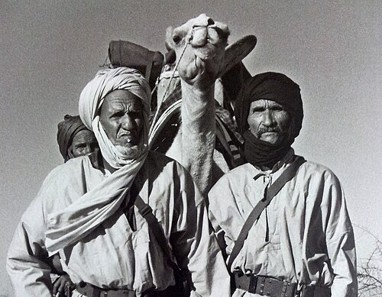
©Quai Branly Museum/Robert Laroche – Sahrawi Fighters of the Polisario Front in 1980
In 2020, the Abraham Accords marked a turning point in diplomatic relations between the Kingdom of Morocco and the United States. Donald Trump, in exchange for the Moroccan monarchy’s recognition of the State of Israel, officially recognized Morocco’s sovereignty over Western Sahara. This tipping point in the existing balance of power was the first in a series of crucial policy shifts in the West. Until then, the former Spanish colonial power had refused to follow in the footsteps of the MAGA (Make America Great Again) administration. In April 2021, these major disagreements came to a head over a critical event. Brahim Ghali, leader of the Polisario Front, was hospitalized in Logroño, Spain, where he was admitted under a false name to receive treatment for COVID-19. For the Moroccan government, this was a scandal: its Mediterranean neighbor was admitting onto its territory and under its protection the man whom the media outlet Le360 described as the “chief torturer.”[20] The consequences were immediate: an unprecedented diplomatic crisis ensued, and the Spanish ambassador was summoned by Morocco.
Monday night, on May 17th 2021, Moroccan authorities withdrew border controls near Ceuta. As more than 8,000 people crossed the border crossing in less than 24 hours, the Spanish defense minister at the time denounced the incident on the radio as “an attack on Spain’s borders as well as the borders of the European Union,” as well as a form of “blackmail[21].” In the wake of this breach, the army was deployed to monitor the border, and the Minister of Foreign Affairs summoned the Moroccan ambassador to Spain to remind her that “border control has been and must remain a shared responsibility of Spain and Morocco[22].”
After decades of relative neutrality in the conflict, the Spanish government announced in March 2022 its support for Morocco’s autonomy plan and officially recognized its sovereignty over Western Sahara. To “seal this new relationship,”[23] on June 24 of that same year, Morocco fiercely defended its border with the enclave of Melilla. According to figures compiled by Amnesty International at the time, “at least 23 people died, and some organizations on the ground counted as many as 37.”[24] At the heart of this striking contrast in the management of cross-border movement, the NGO sees a deliberate strategy: “These human rights violations were committed a few weeks after the agreement reestablishing diplomatic relations between the two countries, following a shift in the Spanish government’s approach toward Western Sahara. This may explain why the Prime Minister of Spain, when reports of the deaths of five people began to surface, congratulated and praised the coordinated action of the Spanish Civil Guard and the Moroccan security forces[25].”
But if relations between the Moroccan and Spanish governments have warmed considerably since this notable shift in position, how can we explain the recurrence of a similar incident in the summer of 2026? Although the Ministry of the Interior continues to deny the existence of a report attributing responsibility for this situation to Morocco, it may stem from a recent rapprochement between Pedro Sánchez’s government and Algeria. Since 2022, relations between the two countries have been strained. In response to Spain’s historic decision, President Abdelmadjid Tebboune suspended a friendship treaty signed in 2002, recalled his ambassador to Madrid, and imposed various restrictions on commercial transactions—including a freeze on banking operations. But for the first time since this diplomatic standoff, the Spanish prime minister paid an official visit to Algeria on July 20, 2026.
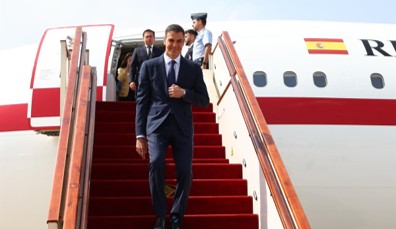
©Pool Moncloa/Fernando Calvo - President of the Spanish government, Pedro Sánchez, at his arrival in Algeria (20th of July 2026)
Accompanied notably by officials from the Spanish energy sector (given Algeria’s status as the leading supplier of natural gas), Pedro Sánchez met with the head of state to discuss issues related to “energy, ways to encourage Spanish investment in Algeria, illegal immigration, and Western Sahara[26].” In light of the long-standing tensions between Morocco and Spain on this issue, it is therefore quite conceivable that the July migration crisis in Ceuta was the result of implicit Moroccan blackmail, directly linked to Algeria’s renewed rapprochement with its adversary.
But while it is important to shed light on the geopolitical stakes and strategies at play behind the scenes of this incident, it is just as crucial to place the experiences of the people affected by this situation at the center of our analysis. Whether on newspaper front pages, in the statements of political leaders, or in public debates, the realities faced by individuals have been largely overlooked. A comprehensive understanding of the crisis in Ceuta necessarily involves examining the reasons that drove such a large number of Moroccans—the vast majority in this case—to leave their country so abruptly, with no guarantee of a safe haven and at the risk of their lives, as well as questioning the fate of those who remain today in an enclave that is ill-equipped to meet such needs.
What place for the people in a Moroccan two-tier economy?
In Morocco, as in neighboring Algeria and Tunisia, the term “harragas” refers to a widespread phenomenon. These people, also known as “burners,” risk their lives attempting to cross the Mediterranean Sea in order to flee the continent or their country of origin. This term reflects the frequent demand by smugglers, who force those seeking exile to “remain anonymous and burn all their identity documents in front of witnesses.”[27] Yet, over the past few years, Moroccan cultural and tourism diplomacy has cultivated the image of a prosperous nation experiencing rapid economic growth.
However, the reality is quite different. According to data from the High Commission for Planning (HCP), the poverty rate has increased sevenfold since the COVID-19 crisis. The latest General Population and Housing Census (RGPH), published in 2024, reveals alarming figures. The national unemployment rate stands at 13.3 percent, more than half of which is “long-term”—that is, lasting more than one year[28]. 25.7 percent of college graduates are unable to find a job, and the unemployment rate among young people aged 15 to 24 peaks at 37.2 percent[29]. These distressed Moroccan youth, who fall outside any support system, have even been given a name: NEETs, or “Not in Education, Employment, or Training.” In contrast to a prosperous Atlantic coastline where the automotive and aerospace industries are flourishing alongside new, state-of-the-art infrastructure (such as the port of Dakhla, Tangier Med, and a high-speed rail line), the country’s rural and inland areas are struggling. As these areas have been left out of this rapid modernization and the current economic boom, access to public services there remains limited. In his Throne Speech on July 29, 2025, Mohammed VI solemnly declared that “there is no place, neither today nor tomorrow, for a Morocco moving at two speeds.”[30] But a few months later, a major social mobilization called attention to this unfulfilled promise.
From September 27 to October 9, the Gen Z 212 movement brought together nearly 200,000 participants, most of whom were young Moroccans. During daily protests—organized on social media and characterized by a leaderless, grassroots structure—thousands of Moroccans raised numerous social demands as a rallying cry to protest the country’s standard of living. These protests emerged in particular in the wake of the August deaths of eight women following cesarean deliveries at the Agadir Regional Hospital. While nearly 900 million euros were invested in preparations for the Africa Cup of Nations (CAN), public services are failing. In major cities, outrage is mounting and voices are growing louder: the money poured into this sporting event has become a symbol of the government’s misguided priorities. In the streets, Gen Z is demanding a better education and healthcare system, broader access to the job market, and a stronger fight against corruption within political circles and society at large. There are also calls for the resignation of Prime Minister Aziz Akhannouch.
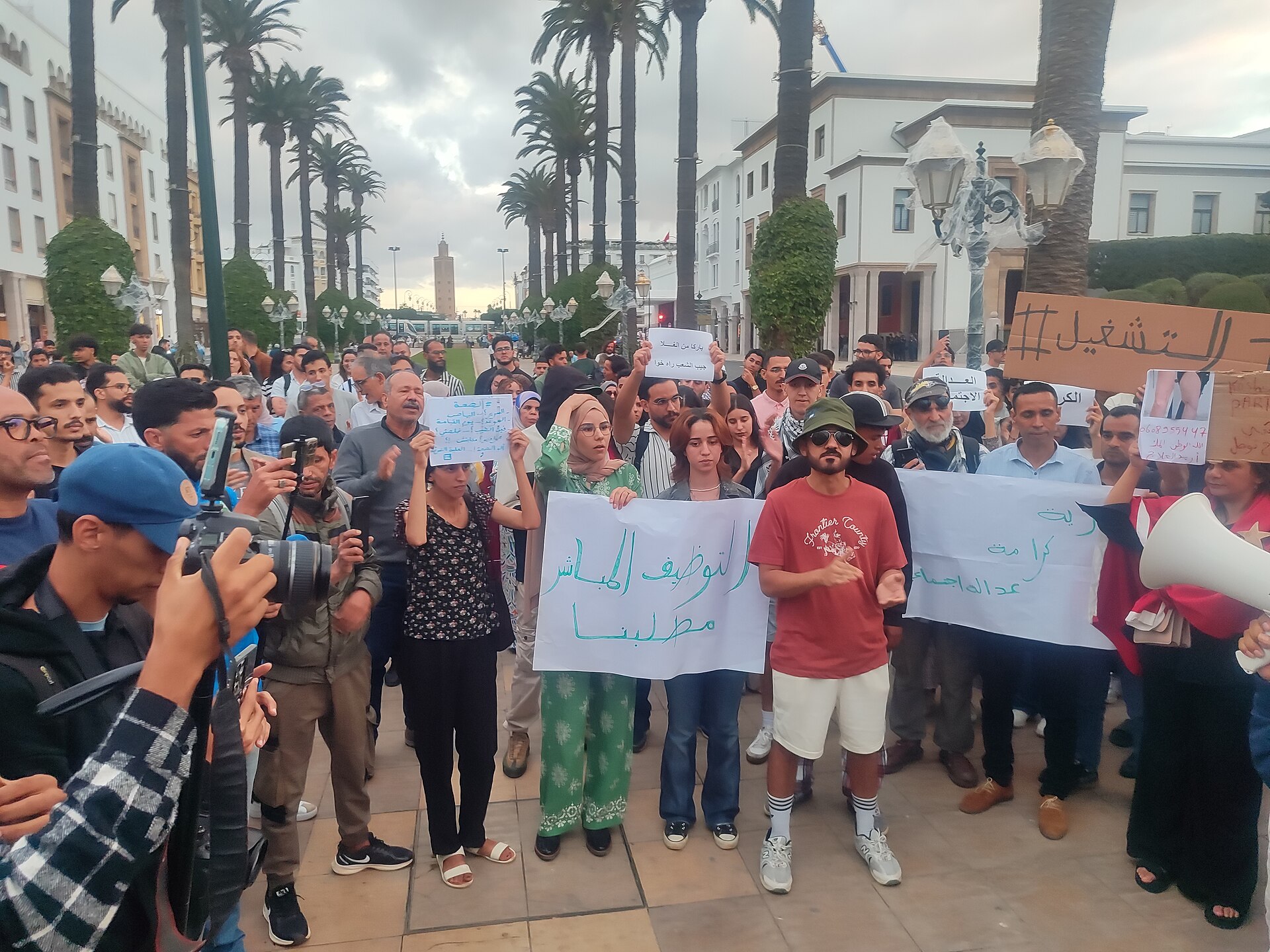
© Mounir Neddi – Gen Z 212 in Rabat (09th of October 2025)
Faced with this unprecedented protest movement, police repression took on extremely violent forms. During this initial phase of the movement—which later resumed on a more subdued scale in December 2025—2,000 people were arrested, and several young people lost their lives during clashes with Moroccan authorities[31]. For several months, videos depicting extreme brutality circulated on social media, fueling widespread outrage. Against the backdrop of this significant and precarious situation, it becomes easier to understand the reasons that drove so many Moroccans to swim to the enclave of Ceuta during the summer. But once they arrived there, their hopes were ultimately dashed, and the conditions they faced did not seem any more favorable.
What next? Asylum seekers caught in the crossfire of violent xenophobic riots
While many have looked the other way since the events of July 31, this chapter is far from over. Currently, nearly 5,000 people are still waiting in Ceuta for a decision on their asylum claims—a figure that is imprecise and widely disputed by local authorities, NGOs, and the Spanish government itself. This massive influx into a population of barely 83,500 residents[32] naturally raises issues of management and governance. The infrastructure for housing, healthcare, and resource distribution is inevitably overwhelmed. Unable to meet this surge in needs, the dedicated local organizations are now being supplemented by spontaneous solidarity groups and associations—some of which are even neighborhood-based. In particular, temporary camps specifically set up for girls and women have sprung up on soccer fields in the Principe Alfonso neighborhood. According to Spanish authorities, 760 minors remain in the country, some of whom have been taken into the care of child protection services, while others are housed in community centers or “under police supervision or custody.”[33] However, members of local organizations dispute these figures and claim that they significantly underestimate the number of minors in the city.
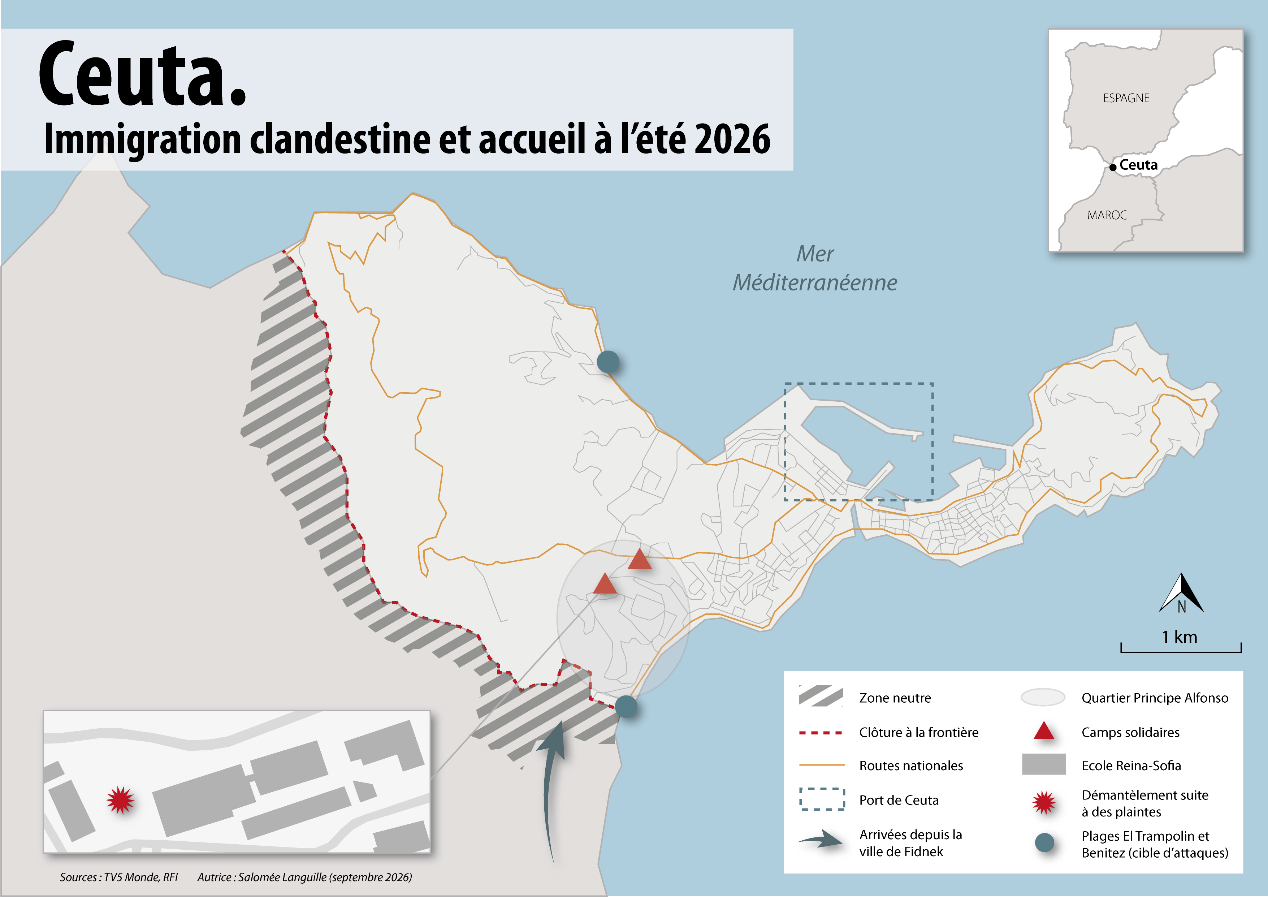
© Salomée Languille – Map made with Adobe Illustrator (September 2026)
But these few acts of solidarity are, unfortunately, not the norm. Since August 27, violence by civilians has been on the rise, as have incidents involving law enforcement. Spanish authorities initially documented 23 cases of sexual violence against young women and girls within the span of a month, nine of which involved minors aged 14 to 17[34]. Furthermore, clashes between nearly 70 migrants and a military patrol—described as an “ambush ”[35]—which led to the arrest of 12 Moroccan nationals—fueled a rise in xenophobic protests across the city. At that time, the Reuters news agency managed to photograph a seaside camp destroyed by its residents, where the occupants’ personal belongings had been thrown in the fire.
Dozens of protesters then staged a sit-in to block Red Cross vehicles attempting to reach El Trampolin Beach for a food distribution. Waving Spanish flags, the crowd also briefly blocked the passage of a convoy of ambulances while chanting various reactionary slogans: “Let them leave,” “Ceuta is Spanish,” and “Out with the Red Cross[36].” Mediapart collected a statement from one of the rioters, who said: “We, the Caballas […] have always felt that at some point, Morocco might invade us, just as it has just happened[37].” Several victims of these disturbances told the same media outlet and RFI that they had suffered various forms of violence. One described “scenes of a manhunt” and recounted having to “flee from the military and residents of Ceuta[38].” Another said that “there is a lot of racism [39]” and that the police advise against entering the city center, as there is a risk of being beaten. Amid this turmoil, local residents have filed complaints and are demanding the closure of the temporary camp set up next to the Reina-Sofia school.
As demonstrations of solidarity are gradually overshadowed by a wave of xenophobic attacks and protests, Interior Minister Fernando Grande-Marlaska has called for “calm and an end to all forms of violence, because […] violence is not the solution to such a complex problem[40].” As the outcry grows across the rest of Europe, where reactionary movements are seizing the moment, both the most conservative and the most progressive circles are demanding action from the Spanish government and better management of the crisis—for the good of some, but not necessarily of others.
BIBLIOGRAPHIE
[1] « Le Premier ministre espagnol dénonce ‘une attaque’ et ‘une violation de l’intégrité territoriale de l’Espagne’, après l’entrée de 60 000 migrants à Ceuta », Franceinfo, July 31st 2026, read on September 8th 2026.
[2] NÚÑEZ FEIJÓO Alberto, https://x.com/NunezFeijoo/status/2092911649959145829, X, August 27th 2026, read on September 8th 2026.
[3] BABIN Justine, « Pourquoi des milliers de Marocains affluent à la nage dans l’enclave espagnole de Ceuta », Les Echos, July 31st 2026, read on September 11th 2026.
[4] HABHOUB Hamza, « À Ceuta, des migrants bloqués aux portes de l’Europe attendent de connaître leur sort », France24, August 17th 2026, September 11th 2026.
[5] « La forteresse Europe continue de tuer », Amnesty International, August 2026, read on September 11th 2026.
[6] FERNÁNDEZ GARCÍA Alicia, « Enjeux économiques et défis sociaux à la frontière hispano-marocaine de Ceuta », Revue de l’Institut des langues et des cultures d’Europe, Amérique, Afrique, Asie et Australie, vol. 58, 2025, pp. 50-71.
[7] Ibid., p. 51.
[8] Ibid., p. 51.
[9] THIOLLET Hélène, « Externalisation. Comprendre la diplomatie migratoire et l’Union européenne », October 2024, p. 3.
[10] POMMIERS Eléa, « À Ceuta, des décennies de crise migratoire entre l’Espagne et le Maroc », Le Monde, May 19th 2021, read on September 9th 2026.
[11] « Le Premier ministre espagnol… », op. cit.
[12] SAUVAGE Grégoire, « Rumeurs, appel d’air, passivité du Maroc… comment expliquer l’afflux inédit de migrants à Ceuta ? », France24, July 31st 2026, read on September 9th 2026.
[13] Ibid.
[14] « Crise de Ceuta : un rapport espagnol sème le doute sur le rôle de la police marocaine », France24, September 02nd 2026, read on September 9th 2026.
[15] ECHCHIHAB Camélia & ESCALONA Fabien, « En Espagne, droite et extrême droite manifestent contre Sánchez et instrumentalisent la crise de Ceuta », Mediapart, September 3rd 2026, read on September 9th 2026.
[16] Ibid.
[17] ÁLVAREZ-MIRANDA Berta & BREY Elisa, « Reframing coercive engineered migration theory: Ceuta and the Western Sahara ». Mediterranean Politics, vol. 30, n° 2, 2025, pp. 316-337.
[18] SAUVAGE Grégoire, op. cit.
[19] « Sahara occidental », Nations Unies, September 20th 2024, read on September 9th 2026.
[20] BOUDARHAM Mohammed, « Vidéos. Brahim Ghali hospitalisé à Logroño, ses victimes relancent la justice espagnole », Le360, April 24th 2021, read on September 9th 2026.
[21] « Migrants à Ceuta : l’Espagne accuse le Maroc d’‘agression’ et de ‘chantage’ », Le Monde, May 20th 2021, read on September 20th 2026.
[22] « Madrid hausse le ton contre le Maroc après l’arrivée de milliers de migrants à Ceuta », France24, May 19th 2021, read on September 9th 2026.
[23] ÁLVAREZ-MIRANDA Berta & BREY Elisa, op. cit., p. 320.
[24] « À Melilla, plus jamais ça », Amnesty International, June 28th 2022, read on September 11th 2026.
[25] Ibid.
[26] « En visite à Alger, le Premier ministre espagnol scelle le réchauffement entre son pays et l’Algérie », France24, July 20th 2026, read on September 11th 2026.
[27] VIDEAU André, « Harragas | Musée de l’histoire de l’immigration | Palais de la Porte Dorée », Museum of the history of immigration, March 8th 2010, read on September 11th 2026.
[28] « Chômage », Moroccan High Commission for Planning, 2024, read on September 11th 2026.
[29] Ibid.
[30] « Le roi Mohammed VI : ‘Il n’y a pas de place pour un Maroc à deux vitesses’ », le Desk, July 29th 2025, read on September 11th 2026.
[31] CUORDIFEDE Célia & ROGER Simon, « Au Maroc, le mouvement ‘gen Z’ refait surface après deux mois d’absence », Le Monde, December 11th 2025, read on September 11th 2026.
[32] « Ceuta », World Population Review, 2026, read on September 11th 2026.
[33] GARCIA MELERO Rodrigo, « Un mois après les nombreuses arrivées à Ceuta, des femmes migrantes isolées et exposées au risque de violences sexuelles », RTVE, September 1st 2026, read on September 11th 2026.
[34] Ibid.
[35] « Vidéo. Espagne : heurts à Ceuta entre manifestants anti-migrants et police », Euronews, August 28th 2026, read on September 11th 2026.
[36] ECHCHIHAB Camélia & ESCALONA Fabien, op. cit.
[37] Ibid.
[38] « Ceuta: les migrants quittent l’enclave et racontent le déchaînement de violence des derniers jours », RFI, August 2nd 2026, read on September 11th 2026.
[39] ECHCHIHAB Camélia & ESCALONA Fabien, op. cit.
[40] « À Ceuta, des manifestations anti-migrants tournent à la violence », France24, August 28th 2026, read on September 11th 2026.
