"It's very complicated to be an LGBT person in our country": during the presidential election in Honduras, a look at the social situation of the LGBTQIA+ community
Erin RIVOALAN-COCHET
June 6th 2026
Historical context of Honduras
Honduras has experienced several authoritarian regimes and violent transfers of power. After gaining independence from Spain in 1821 and then from Mexico in 1823, a two-party system emerged between liberals and conservatives. It was only at the beginning of the 20th century that a third party, the Partido Nacional (National Party – PN), was formed. The economy of this Caribbean nation relies primarily on the export of natural resources and the development of foreign multinationals, mainly American, within its borders. This situation led to the first political polarizations, before culminating in civil wars beginning in 1924. Honduran society is primarily divided between, on the one hand, wealthy landowners and agricultural workers within agricultural structures, continuing the legacy of the Spanish colonial haciendas; and on the other hand, a population developing a production economy, composed of wage earners and unions. Following political uprisings and a military coup, Honduras entered into conflict with its neighbors, Nicaragua and El Salvador (which had experienced revolutions in the late 1970s).
Political instability continued into the 21st century, with the ouster of President Manuel Zelaya in 2009 following a military coup. This coup led to the election of a new president, Porfirio Lobo of the Partido Nacional, who remained in office until 2014. Lobo reached an agreement with the ousted president to resolve the political conflict. In the wake of these agreements, Manuel Zelaya founded the Liberty and Refoundation Party (Libre). However, despite the return to a two-party system, these same agreements normalized the actions of those responsible for the coup, as well as the systematic disregard for human rights. Political instability persists, particularly at the ballot box with irregular elections during the 2010s. At the same time, living conditions are deteriorating. In 2019, 40% of the population lived in extreme poverty, a figure that rose to 54% in 2021 (1). A large number of Hondurans are attempting to emigrate to the United States, Spain, or Mexico. Violence is widespread, with a homicide rate of 41.4 per 100,000 inhabitants in 2018 (2).
In 2022, Manuel Zelaya’s partner, Xiomara Castro of the Libre party, won the presidential elections. Her government implemented several social reforms and agrarian measures, despite the still-strong legacy of the 2009 coup (3).
On November 30th, Honduras elected its new president, Nasry “Tito” Asfura of the National Party. A career businessman and politician from the neoliberal conservative right, his campaign was based on promises of security and support for the free market (4). Facing him were two other leading candidates. One was Rixi Moncada (Free Party), a politician close to outgoing President Xiomara Castro. Having held several positions under the governments of Manuel Zelaya and Xiomara Castro (between 2006 and 2009) and supported by a rural and working-class electoral base, she promised to continue her predecessor’s policies. The other was Salvador Nasralla (Liberal Party, center-right/right), running for president for the fourth time. A television presenter, his campaign emphasized anti-corruption, a popular issue among the Honduran population. He ran alone during this campaign, lacking support from his party (5).
After three weeks of suspected fraud, suspended vote counting, and repressed protests, the results were officially announced on December 24. The National Electoral Council (Honduras’ highest administrative electoral authority) declared Nasry Asfura the winner, the preferred candidate of US President Donald Trump, with whom he had already initiated plans to destabilize the governments of Claudia Scheinbaum in Mexico and Gustavo Petro in Colombia through massive disinformation campaigns and the transfer of power to former President Juan Orlando Hernández, who had been convicted of drug trafficking in the United States before being pardoned by Donald Trump and supported for his return to power in the Caribbean nation by both Trump and Benjamin Netanyahu, as recently revealed by the “Hondurasgate” scandal (6) this past April.
The results of the 2025 Honduran presidential elections were a major concern for several Honduran human rights defenders, such as Somos CDC and Arcoíris, in an international context of US budget cuts. Somos CDC (Center for Development and Cooperation) and Arcoíris (Rainbow) are two human rights organizations working by and for the Honduran LGBTQIA+ community. The NGO Somos CDC works to implement projects aimed at improving the living conditions of LGBTQIA+ people in the country, through programs promoting political participation, access to justice, economic development, and communication to foster cultural change. The Arcoíris association emerged from an initiative among friends from this community and aims to develop actions to promote the human rights of LGBT+ people. She works primarily on political advocacy, raising awareness of health rights, sexual and reproductive education, and HIV prevention. Persecution of LGBTQIA+ people is widespread in the country, with at least 565 members of the community murdered between 2004 and 2024 (7). The Honduran Observatory of Violence Against LGBTQIA+ People (Observatorio de Violencia Hacia las Personas LGBTQIA+) reports an impunity rate of over 98% for these murders. In 2024, the Observatory also recorded 311 complaints of violence against members of the community and documented one missing person as well as 38 cases of assistance to refugees abroad (8). More generally, in 2024, Amnesty International pointed out that Honduran authorities persisted in militarizing public security, with excessive use of force (9). That same year, Global Witness warned that Honduras was one of the countries with the highest number of homicides against human rights defenders, particularly those defending their territory and the environment (10).
Because of this situation, two representatives from Somos CDC and Arcoíris, Daniela Mondragón and Esdra Sosa, traveled to France. This was part of a European international solidarity tour to participate in the pre-session of Honduras’ Universal Periodic Review (11) (UPR**), and to meet with representatives of the UN, states, and NGOs. Dating from September 2025, their stay in France provided an opportunity to interview them about the Honduran context of the LGBTQIA+ community, citizens’ rights and political uncertainties a few months before the presidential election.
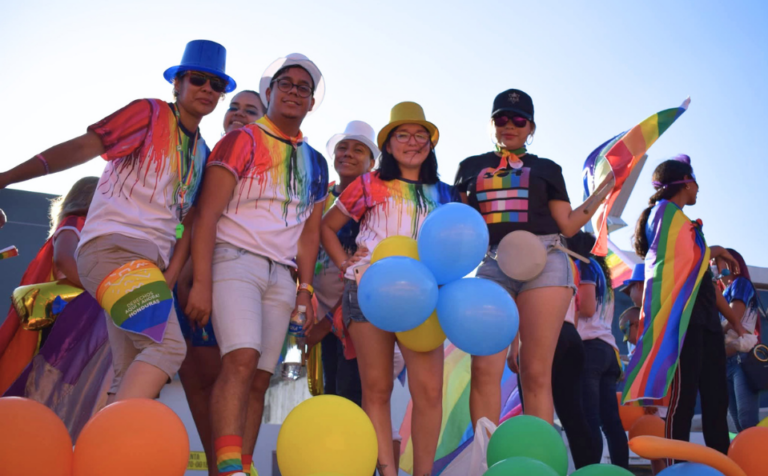
Arcoiris
Presentation by Daniela Mondragón, Esdra Sosa and the PBI
Daniela Mondragón is a lawyer and legal advisor at Somos CDC. She defends the rights of LGBTQIA+ people and works to improve the legal conditions of the community in Honduras.
Esdra Sosa is the director of Arcoíris and has been an activist for the rights of the Honduran LGBTQIA+ community for over twenty years. She is also a member of the KAI+ Observatory, which reports on all instances of violence against LGBTQIA+ people in Honduras.
Peace Brigades International (PBI) is an NGO that has been working on the ground for over 40 years to support human rights defenders in their local and national activities. Present in eight countries, PBI is an organization that promotes non-violence and also conducts observation, advocacy, and awareness-raising missions for human rights through an international network.
Can you explain what you do as human rights defenders for the Honduran LGBTI+ community?
Daniela Mondragón: Somos CDC is a Honduran civil society organization that has been working for over eighteen years to promote and defend the human rights of the Honduran LGBTI+ population. We develop initiatives through our programs focused on access to justice and human rights, management for cultural change, and economic empowerment.
Esdra Sosa: For twenty-two years, Arcoíris has been working to defend and promote human rights. We work in the field of political advocacy, using hate crime investigations. We also conduct prevention missions for sex workers regarding the HIV pandemic and sexually transmitted infections. I am a nurse myself. Arcoíris is housed in a large space shared with other lesbian and bisexual women’s associations, Litos, which is short for “futbolito” [little football]. Most of the people coordinating the association played football, so they could play on a fast, indoor pitch and present their work or a specific topic related to the demands of lesbian and bisexual women, while also raising awareness of their work. One of the goals was to attract more people interested in joining our group, and then end with a football match. We also work with the transgender women’s collective Muñecas de Arcoíris [Arcoíris Dolls], a group we are very proud to have among us. In 2024, this collective received the Frontline Defenders Award [an international organization defending the human rights of activists (12) – ed.] for its work promoting the rights of transgender people. Our three collectives form a roundtable on access to justice. We are members of a committee on sexual diversity that brings together more than ten organizations. This is a political platform where we exchange views on the various contexts the country is facing, such as the general elections [of November 30, 2025], statements in the media, and religious fundamentalism. We are also part of a working group with lesbian and bisexual women on the issues of migration and displacement. We also participate in an observatory on violence against LGBT+ people, alongside two other organizations of gay men, lesbian women, and transgender men and women. The observatory is called KAI+, an acronym for the three organizations that comprise it: Kukulcán, Arcoíris, and Ixchel. Its work focuses on four areas: widespread violence, violent murders against LGBT+ people, human mobility, and significant historical events related to human rights violations against LGBT+ people. Together, we work to promote and defend human rights. We do not use the term “queer” because we do not consider ourselves part of that movement. A strong queer movement has not emerged within our organizations. Nevertheless, we work with LGBT+ people, which is why we add the “plus.” Some people do not yet identify as such, and some intersex people are not members of our group. However, we welcome leaders from all these queer organizations and young people who wish to become members of our openly LGBT+ organizations to work for the community in Honduras.
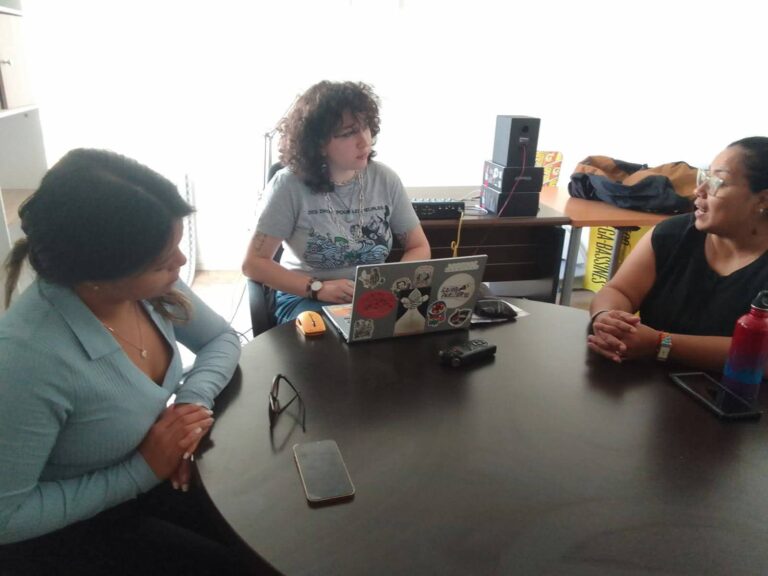
Entretien entre Erin Rivoalan-Cochet, Esdra et Daniela.
Do you play football to raise awareness about the situation of the LGBTQIA+ community and to create your own space?
ES: But also for our mental health! We are still discriminated against in our homes, in society as a whole, because of our gender expression, because some people are more masculine, have a different way of dressing, a different way of expressing who they are and who they want to be. So we make sure that these people can take their minds off things, have fun. We run other cultural and artistic activities such as painting exhibitions, retro-educational camps, beauty pageants for transgender, gay, and lesbian people… All these activities reflect the violent environment of our homes, of society as a whole, and of the various spaces where we are not welcome. For example, in shopping centers, people with a transgender identity are treated violently. When we see that these transgender men and women want to use the restroom corresponding to their gender expression, we call security and we turn them away. Even if exclusion isn’t the primary intention, that’s what happens in practice. In parks where things might be a little more open, the municipal police harass LGBT+ people, saying we can’t be in these spaces because we’re bad examples for children and the elderly. We laugh, we have fun, we talk about all sorts of things, but they can clearly see that we’re LGBT+, even if sometimes we’re not identified as such, like when I’m not wearing this bracelet [in the colors of the LGBT rainbow flag – ed.]. Perhaps for some people, their orientation is more obvious than for others, but we live in this space and we can’t hide who we are. As a result, we’re also victims of street harassment, usually from men, when we’re in shared public spaces, in parks. It is therefore very complicated to be an LGBT person in our country, because we are still perceived as an aberration, as persona non grata under the law.
The Office of the United Nations High Commissioner for Human Rights (OHCHR) described Honduras as one of the most hostile and dangerous countries for human rights defenders in 2016. That was almost 10 years ago. How has the situation evolved since then, particularly with regard to the human rights of LGBT+ people?
ES: He wasn’t wrong. These are very strong statements, certainly, but true and verifiable. Thanks to all the work done by the legal departments of our LGBT+ organizations, we can attest that our requests are taken into account by these departments. However, when we report something to the public prosecutor’s office in our country, or to the system meant to protect human rights defenders, they fail. None of these systems have the necessary language to address our demands as LGBT+ people. It is therefore in this area that we are working to develop laws and protocols that ensure our demands are taken into account. If there is no proper procedure for handling complaints from LGBT+ people, they are subjected to violence and their complaints go unheard. Since 2016, in collaboration with organizations, we have implemented a Universal Periodic Review to monitor violence (13). We began working on these projects well before then; however, 2015 and 2016 were among the most violent years, a period when there was no observatory reporting hate crimes committed against us. Since 2020, the year in which several of these Universal Periodic Reviews were conducted, Honduras has received fifteen recommendations concerning LGBT+ people. To date, none of them have been implemented. Furthermore, the Commissioner for Human Rights, who works closely with us to document and highlight all human rights violations against LGBT+ people and who is our only direct ally, uses our legal services. This work must continue constantly; the risk is that we will remain at the stage of promises or declarations on paper. I can already say that between 2020 and March 2025, we recorded the deaths of 194 LGBT+ people and an impunity rate of approximately 93%. This rate is rising because there is no political will on our side to propose laws that protect us and protocols for differentiated treatment within the judicial system.
Among these, the Equality and Equity Bill has highlighted the many difficulties faced by various populations who are victims of oppression, or even marginalization. What stage is this bill at right now?
ES: It was a draft bill because the law already exists as such. This draft is a form of contribution to that law, which we then provide to each body, such as the National Congress. However, these institutions do not receive us or accept our contributions. They do not implement any revisions, even for testing purposes, because we are asking members of the National Congress or any other institution for additional rights. This is perceived as privilege when we promote or develop laws for the rights of people in the LGBT+ community.
DM: This Equality and Equity Bill exists because of the need to reduce discrimination against all people who consider themselves to be in a vulnerable situation. Its development began approximately 18 years ago. It went through various processes because initially it was only considered an LGBTI law. This often limited the state’s participation in thematic roundtables. Consequently, until 2023, the OHCHR provided technical support for a new revision of the LIE [Ley de Igualdad y Equidad – Equality and Equity Law]. During this revision, we formed different working groups composed of women, LGBTI people, and state representatives. This led to the draft bill we have now. This draft was submitted to the Secretariat of Social Development, as well as the Secretariat of Human Rights. To date, however, we have not been able to obtain the support of the members of Congress. Many members of parliament – primarily right-wing conservatives – believe that the LGBTI community is seeking privileges to promote gender ideology among children, enabling them to undergo gender reassignment at a very young age and access hormone therapy. The proposed law would therefore complement the existing penal code, which defines discrimination as a crime. But what exactly constitutes a crime? The wording is ambiguous. In other words, the public prosecutor is unable to determine whether a case is based on sexual orientation or not. This often limits LGBTI people’s access to justice.
In addition to the laws, isn’t there also a whole issue surrounding stigmatization and discrimination on a socio-cultural level?
DM: Yes, the Honduran population is significantly macho, which limits any form of acceptance of the LGBTI population, such as the inclusion of its members within the family—the first level of social interaction before that of society. This is why many people are interested in organizations to learn more about them, understand the context in which they operate, and thus begin volunteering.
What challenges did you encounter during the presidential elections of November 30, 2025?
DM: In the context of the national elections in Honduras, there are first internal elections where each party nominates its candidates for president, mayor, and deputy positions, depending on the department. This process took place in March and was arduous. This resulted in a day of voting that generated considerable chaos, as the final results were not clearly established. The three commissioners of the National Electoral Council were in conflict and unable to reach an agreement. It was necessary to implement processes to recruit a large number of staff for the elections. This conflict lasted approximately two months. There were five political parties, each with its own representative: four men and one woman. One of these parties [Mario “Chano” Rivera’s Christian Democratic Party] proposed that Honduras join the United States as a new state (an objective that infringed upon its sovereignty). Another candidate, the most professionally prepared for the elections but lacking political support, was the candidate of the Partido Nacional [National Party]. Nasry “Tito” Asfura was the mayor of the capital, Tegucigalpa, and is currently on trial for embezzlement of public funds and abuse of power. The Liberal Party candidate, Salvador Nasralla, has never held public office, having always worked as a television presenter. His political discourse asserts that Honduras must return to traditional religious values. We already know that religion is always opposed to what LGBTI people represent. Finally, the candidate of the Free Party (Partido Libertad y Refundación, Rixi Moncada), the party of the current president (Xiomara Castro), assures that she will continue the policies already implemented by the current government (agrarian and social reforms, the fight against crime). Polls indicate that the presidential election will be won by either the Liberal Party or the Free Party. But what will the consequences be? The Free Party could continue to develop initiatives in favor of the LGBTI population, as the current government has already done. Previously, homosexual people could not donate blood. This prohibition has now been abolished. A directorate for inclusion policies within the Secretariat for Development and Social Inclusion has been created, but unfortunately, it has no budget and is staffed by only one person, which makes its work somewhat difficult. We are seeing LGBTI people openly asserting themselves and expressing their gender identity in various ministries. Xiomara Castro did not do much more than this, but she owes a debt to the entire population as the first female president. Women now have even more to expect from her. The candidates from the Liberal Party and the National Party represent a danger because they are very conservative right-wing parties. When the National Party was in power for twelve years, it effectively “locked down” the Constitution. It was enshrined in law that homosexual people could not marry and that same-sex marriages contracted abroad would not be recognized by the Honduran state. It has also been established that to reform this article, and thus grant the right to marriage for all, at least 95 votes out of the 128 members of parliament would be required. In other words, it is completely impossible. Under the twelve successive governments [since the 1982 constitutional reform – ed.], we have always experienced repression against demonstrations, associations… Many people have lost their lives for marching and showing their opposition to the government’s actions. This is the context in Honduras, marked by incredible political violence. I believe that, until 2025, I have never seen so many attacks between parties, between candidates, members of parliament, women, men…
We know that social mobilization is often difficult, but what about access to voting, particularly for the LGBT+ community?
DM: Freedom of expression and assembly has improved, since there is no longer violent repression from the national or military police as there was before. The right to association has also improved, but there have been setbacks. What particularly concerns us are organizations that have been requesting recognition for three years and are not being granted it because their members are LGBTI. Even though I think there has been some openness on the part of the government [of Xiomara Castro – ed.], there is still much to be done. Regarding suffrage, surveys conducted by civil society indicate that transgender people suffer the most from stigmatization in accessing the right to vote. Logically, since people go to the polls with their national identity card indicating the gender assigned at birth, this leads to questions and then mockery. People at the polling stations make comments about their clothing and call them deviant. Transgender victims of these remarks are therefore less and less likely to vote.
ES: Politicians are united by religious fundamentalism to promote smear campaigns. Several politicians are using Honduran youth laws to deny the right to change one’s name, gender, and access to hormone therapy. A campaign was launched with the slogan “Don’t touch my children” [Con mis hijos no te metas – ed.]. We are facing the incitement of hatred from religious fundamentalists, in addition to media outlets that misinform the public about these kinds of attacks or only show what they want to show about LGBT people… These same people are the ones who protest the most. There has already been a “Hands Off My Children” demonstration, bringing together politicians and religious figures, who proclaimed that they would not accept our country “being inhabited by aberrations alongside minors.” We are even accused of pedophilia because of the statements these politicians make from their podiums, from the demonstrations they organize. These pronouncements are also fueled by the media, which engages in tabloid journalism while stigmatizing and discriminating against LGBT+ people. The media reuses images from past mobilizations to ridicule and misinform the population. This makes the media landscape even more violent. As Daniela mentioned, as an LGBT+ Honduran wishing to exercise their right to vote, we find ourselves voting for the parties participating in these marches. We therefore explain that these two parties, represented by men, will pursue policies fueled by the traditional values of what constitutes an “exemplary family.” We therefore hope that Rixi Moncada wins, so that she will continue to support us. Even if we remain stuck with promises, as when the current president, Xiomara Castro, won and we thought there would be positive change for LGBT+ people, or greater access to the three points Daniela mentioned, which have seen little progress today: name change, gender reassignment, and access to hormones. Similarly, a ruling by the Inter-American Court of Human Rights, another mechanism also used by our legal services to highlight violations committed against people who wanted to marry or have marriages recognized outside of Honduras but were unable to do so, has not been implemented. This is due in particular to this lack of political will and the absence of laws that protect, defend, and guarantee our rights.
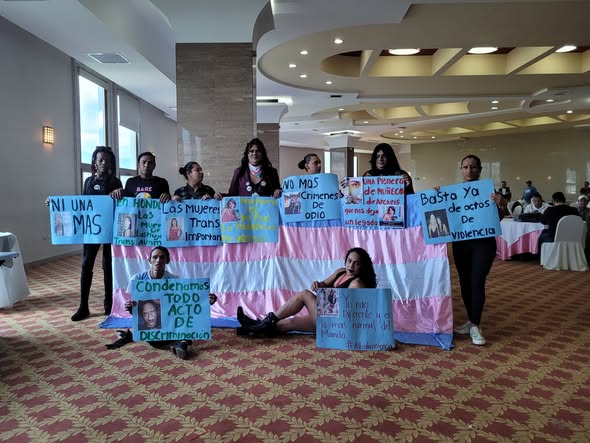
Human Rights, Sexual and Gender Diversity Forum, Honduras
So what are your strategies for opening a dialogue with conservative individuals?
ES: We always invite people with the power to act and make decisions. However, these people always claim they don’t have time, that they had to leave the country urgently, or that they are dealing with other, more important matters than meeting with LGBT+ people. They send their assistants to tell us, “Oh dear, the minister apologizes, but I can pass on your information and requests.” But that’s where it ends: referring us to a meeting with assistants from the ministry. So there’s no progress, nor any political will to act. The organizations themselves, like ours, Somos CDC, say they are ready to allocate a budget to carry out joint actions with the ministries. In reality, it’s the LGBT+ human rights organizations that provide this budget to continue their work. These organizations themselves establish the budgets and convene all the other associations. Currently, no one visits a member of parliament to demand accountability for differentiated protocols or laws supposedly implemented over the past ten years. This doesn’t happen because these individuals are afraid of being accused of being homosexual, left-wing, etc. This can hinder their work. The same applies to the legal services that handle our complaints. They are partners with us, are part of the LGBTQ+ community, and also face harassment from the authorities for defending LGBTQ+ people or advocating for their rights.
What is the impact and legacy of the 2009 coup on your human rights work?
ES: It had a tremendous impact on us. Civil society as a whole, not just LGBTQ+ movements, has been able to organize more effectively since then. However, the state has repeatedly tried to dissolve us in order to stop the unifying work we are doing. In all honesty, we LGBT+ people are more united than other groups. We never stop working. It’s as if we have a moral obligation to what the Honduran state owes us. So we make sure our work is a daily commitment: to defend and live, to live in accordance with our laws, our protocols, and our LGBT+ actions in Honduras.
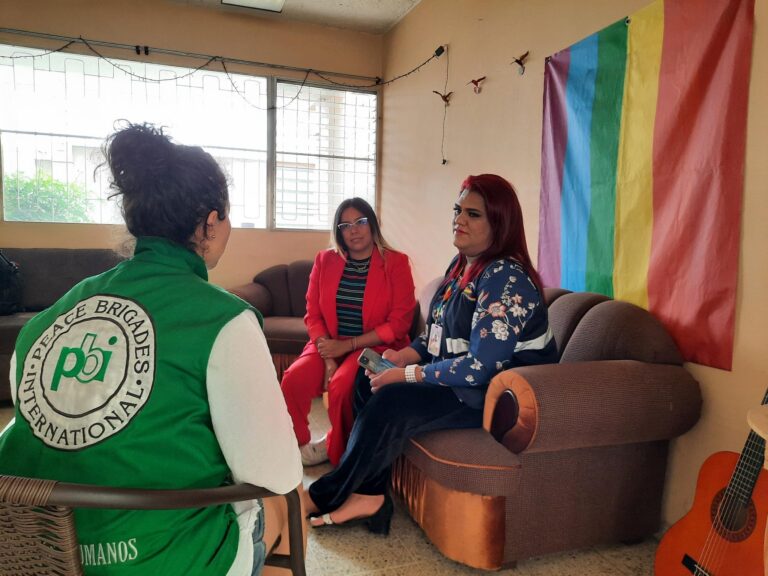
Visite de Loren López et Jlo Córdova a la Casa PBI
How does the international community, including NGOs like the International Peace Brigades (PBI), support you in defending your actions and demands?
ES: We don’t only receive support; we also suffer setbacks. Other organizations that had many projects underway can now only continue 50% of them. There are many cooperation agreements between Honduras and other countries, such as the United States. Since Donald Trump’s statements [regarding USAID budget cuts in 2025 (14) – ed.], almost 80% of NGOs have stopped their activities or no longer have funding. It is now more difficult for them to promote our laws or to conduct political advocacy for the rights of LGBT+ people. Legal services are even more overwhelmed and have reduced budgets, which forces them to prioritize. But everything is a priority! Sometimes, when we present ten priorities to LGBT+ organizations, we’re told, “No, we can only choose three, one for each right: one for the right to health, one for the right to education, one for the right to work, or one for the right to access justice.” Cooperation now depends on us, and it’s very difficult because we find ourselves in situations of competition between organizations. Different causes are pitted against each other: the rights of LGBT+ people, climate change in our territories. Defenders of the land, rivers, and other rights are also dying, and as Honduran LGBT+ people, we feel deeply concerned. But we’re also competing with organizations that defend religious fundamentalism, even if they sometimes also defend human rights. Sometimes it’s even with our feminist comrades, with the government, and of course, the funds will go to the government. It’s always important to consider the economic aspect when taking action. Many members of the community work day-to-day, particularly in sex work, which makes their housing situation precarious. As an LGBT+ individual or organization, you can be evicted if you rent space near a church, or near residences that don’t want LGBTQ+ neighbors and collect signatures to evict you or tell you, “You can’t be here, it’s immoral.” The Arcoíris association has been evicted several times, even though it had the budget to pay the rent and was in compliance with the law. These false allegations often discredit our organizations. People are said to come here to do drugs, and the neighborhood is manipulated to evict organizations, which makes things very difficult.
For your organizations, combating misinformation in certain media outlets and online forums about what these people say or don’t say must certainly be a real challenge…
ES: Or what is said wrongly! People are starting to stigmatize a group because of media outlets that promote hatred towards LGBT+ people.
(*) “LGBT+” is the acronym used by both interviewees.
(**) Established in 2006 and organized by the UN Human Rights Council, the Universal Periodic Review (UPR) is an assessment of the human rights situation and respect for human rights in Member States every four and a half years.
BIBLIOGRAPHY
[1] VASQUEZ Daniel, « Le Honduras dans l’abîme », Problèmes d’Amérique latine, n°116, 2020, pp. 89-101. [online], consulté le 29 mars 2026 : https://shs-cairn-info.accesdistant.bu.univ-paris8.fr/revue-problemes-d-amerique-latine-2020-1-page-89?lang=fr
[2] Ibid
[3] LEMOINE Maurice, « Au Honduras, la gauche défend son bilan », Monde diplomatique, 2025, pp. 4-5, [online], consulté le 16 mars 2026 : https://www.monde-diplomatique.fr/2025/11/LEMOINE/68931
[4] « Présidentielle au Honduras: le conservateur Nasry Asfura, soutenu par Donald Trump, déclaré vainqueur », RFI, 2025 [en ligne], consulté le 27 décembre 2025 : https://www.rfi.fr/fr/am%C3%A9riques/20251224-pr%C3%A9sidentielle-au-honduras-le-conservateur-nasry-asfura-soutenu-par-donald-trump-d%C3%A9clar%C3%A9-vainqueur
[5] MAZARIEGOS Miranda, « Honduras: Meet the Candidates 2025 », Americas Quarterly, 2025. [en ligne], consulté le 25 mars 2026 : https://www.americasquarterly.org/article/honduras-meet-the-candidates-2025/
[6] DUARTE GALLEGUILLOS Valeria, « EXCLUSIVA: Audios revelan que Israel pagó la liberación de Juan Orlando Hernández y que Trump lo está ayudando a regresar a la presidencia de Honduras », Diario Red, 2026. [en ligne], consulté le 25 mai 2026 : https://www.diario-red.com/articulo/america-latina/exclusiva-audios-revelan-que-israel-pago-liberacion-juan-orlando-hernandez-que-trump-ayudando-regresar-presidencia-honduras/20260429021833068541.html
[7] « Violencia y discriminación cotra personas LGTBI persisten en Honduras, con 565 asesinatos », SwissInfo, 2025. [online], consulté le 28 mars 2026 : https://www.swissinfo.ch/spa/violencia-y-discriminaci%C3%B3n-cotra-personas-lgtbi-persisten-en-honduras%2C-con-565-asesinatos/88900667
[8] Ibid
[9] « Honduras 2025 »,Amnesty International, 2026. [online] consulté le 29 mars 2026 : https://www.amnesty.org/fr/location/americas/central-america-and-the-caribbean/honduras/report-honduras/
[10] « Plus de 2 100 défenseurs des droits fonciers et environnementaux tués à travers le monde entre 2012 et 2023 », Global Witness, 2024. [online], consulté le 7 mars 2026 : https://globalwitness.org/fr/press-releases/plus-de-2-100-defenseurs-des-droits-fonciers-et-environnementaux-tues-a-travers-le-monde-entre-2012-et-2023/
[11] Office of the High Commissioner for Human Rights, « Examen périodique universel (UPR) – Accueil », OHCHR. [online], consulté le 29 mars 2026 : https://www.ohchr.org/fr/hr-bodies/upr/upr-home
[12] « About us. The front line defenders story », Front Line Defenders. [online], consulté le 25 mai 2026 : https://www.frontlinedefenders.org/en/about-us
[13] Comité de la Diversité Sexuelle du Honduras (CDSH) ; Brigadas Internacionales de Paz (PBI) Honduras, « No estamos pidiendo privilegios. Informe elaborado para el Examen Periódico Universal (EPU) de Honduras de noviembre de 2025 », juin 2025. [online], consulté le 15 septembre 2025 : https://pbi-honduras.org/sites/default/files/2025-06/PBI%20-%20CDSH%20-%20Informe%20elaborado%20para%20el%20Examen%20Peri%C3%B3dico%20Universal%20%28EPU%29%20de%20Honduras%20de%20noviembre%20de%202025.pdf
[14] TANIS Fatma, LANGFITT Frank, « The Trump administration kills nearly all USAID programs », NPR, 2025. [online], consulté le 28 mars 2026 : https://www.npr.org/sections/goats-and-soda/2025/02/26/nx-s1-5310673/usaid-trump-administration-global-health
Sources pour aller plus loin :
- « The 20th century », dans Encyclopaedia Britannica, article « Honduras », dernière mise à jour le 5 mars 2026, [en ligne] : https://www.britannica.com/place/Honduras/The-20th-century (consulté le 3 mars 2026).
- DEMYK Noëlle ; GARIBAY David ; LARA Oruno D. (et al.), « Honduras », dans Encyclopædia Universalis, Encyclopædia Universalis, [en ligne] : https://www-universalis-edu-com.accesdistant.bu.univ-paris8.fr/encyclopedie/honduras/ (consulté le 3 mars 2026)
